
Cramp Bark | All Naturals Skip to main navigation Skip to main content

Header Search

Account Menu

🌿 Hello, friend Naturally yours 🌸
  • 🔑 Log In ›
  • 📝 Register ›
  • 🔒 Reset Password ›

Site branding

All Naturals
All Naturals
As. was. intended.

Main navigation

  • 🕯️Products
    • 📝 Reviews
    • Ingredients List
    • 🌿 Ingredients Tags
    • 🕯️ Candles
    • 🧪 Tinctures
    • 💚 Salves
    • 🫧 Soaps
    • 👕 Clothing
    • ✨ Accessories
    • 🛍️ All Products
  • 🧠 Knowledge
    • Are Fragrance Oils Dangerous? An Honest Look at Scented Soap, Candles, and the Word "Fragrance"
    • The Cold Truth About Raw Salad: A Chinese Medicine Perspective, Backed by Science
    • The Parasite Trio: Wormwood, Clove & Black Walnut — and Why You Clear the Metals First
    • Green Detox: What Leafy Greens Really Do for Your Body's Cleanup Crew
    • Cold-Season Kitchen: Honey, Sage, and What Actually Helps a Sore Throat
    • The Wellness Pantry: Hand-Grown Herb Blends, Salts, and Fruit Preserves
    • Golden Roots: What Turmeric and Ginger Actually Do (and How We Use Them)
    • Beyond Binders: What Actually Pulls Heavy Metals Out of the Body (and the Redistribution Trap)
    • How Detox Binders Work: Clearing Heavy Metals, Microplastics, and Parasite Toxins from the Body
    • Bentonite Clay as a Binder: What the Research Says About Clay and Toxins
    • Activated Charcoal as a Binder: The Science Behind Medicine's Oldest Sponge
    • Fulvic Acid as a Binder: What the Science Actually Says About Humic Substances and Detox
    • Herbal Salves and Balms: What Really Goes Into a Truly Healing Recipe
    • Herbal Salve for Eczema: 5 Herbs That Calm Irritated Skin Naturally
    • What Makes a Candle Truly Natural? A Closer Look at Wax, Wicks, and What You're Really Breathing
    • Did you know? Scent is the only sense that completely bypasses the blood-brain barrier
    • The plants are speaking to us — Are you truly listening?
    • How your brain blocks pain: The gate control theory explained
    • Why we use 20 herbs in one formula for pain relief
    • Integrative health professionals and natural wellness practitioners
    • How Natural Essential Oils Affect You When You Breathe Them In
  • 🫧 Detox
    • The Parasite Trio
    • 🥬 Green Detox
    • 🧲 Detox Binders
      • How Detox Binders Work
      • Beyond Binders
      • Fulvic Acid
      • Bentonite Clay
      • Activated Charcoal
  • 🔐 Login

Cramp Bark

Main page content

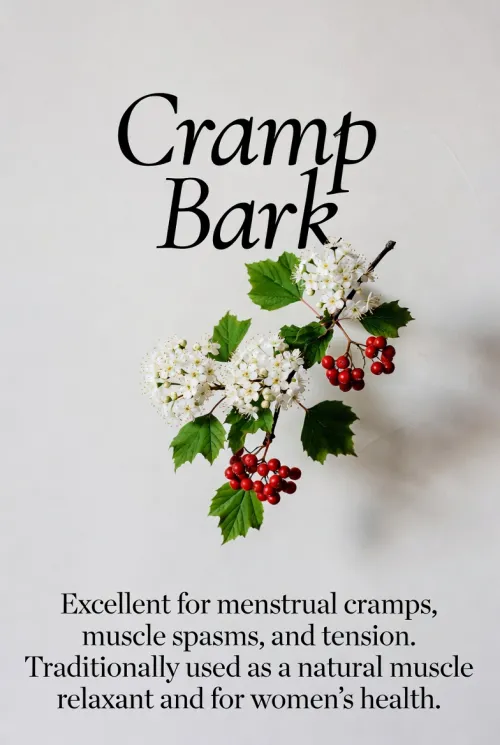
Cramp bark (Viburnum opulus) is one of the most respected and widely used muscle-relaxant botanicals in Western herbalism. As its name plainly declares, this beautiful hedgerow shrub has been used across Europe and North America for centuries to ease muscular cramps, spasms, and tension — from uterine cramps to tight back muscles to leg cramps. Its active compounds work directly on smooth and skeletal muscle to reduce excessive tone and promote natural relaxation.

Key Benefits of Cramp Bark

  • Contains viopudial, scopoletin, and isovalerianic acid — compounds that directly relax smooth and skeletal muscle by reducing calcium-mediated muscle contraction. (PubMed reference)
  • One of the most effective natural antispasmodic herbs — traditionally prescribed by herbalists for menstrual cramps, intestinal spasms, back muscle tension, and leg cramps.
  • Works at the nerve-muscle junction to reduce excessive nerve firing that drives sustained muscle spasm and cramping.
  • Provides genuine anti-inflammatory action alongside its antispasmodic effect — reducing both the pain and the inflammatory component of muscle injury.
  • Used in Native American and European folk medicine as a key remedy for any condition involving muscular over-contraction or spasm.
  • Works synergistically with valerian root and skullcap — creating compound formulations that address both the muscular and nervous system components of tension and cramping.
  • Traditionally used by women healers as one of the primary women's herbs for relieving dysmenorrhea (painful menstruation) and uterine tension.

Cramp bark is nature's direct answer to muscle tension — not masking pain through numbing, but actually addressing the underlying over-contraction that causes it. In skilled hands and formulas, it delivers genuine, targeted relief that complements and extends the action of other analgesic botanicals.

Traditional Chinese Medicine (TCM) Perspective

While Cramp Bark (Viburnum opulus) is not in the classical Chinese pharmacopoeia, its primary action — relaxing smooth and skeletal muscle spasm — maps directly onto TCM's principle of "relaxing sinews and unblocking the channels" (shū jīn tōng luò, 舒筋通络).

  • TCM Classification: Herbs that relax sinews, free the channels, and relieve pain
  • Nature & Flavor (functional): Cool; Bitter, slightly Sour
  • Meridians Entered (functional): Liver, Uterus
  • Key TCM Actions: Relaxes sinews and muscles, unblocks the channels, relieves spasm and cramping pain, soothes the Liver (which "governs the sinews"), regulates the Chong and Ren meridians for uterine spasm.

In TCM, muscle cramps and spasms are understood as Liver-governed sinews that have lost their nourishment (Blood deficiency) or are obstructed by Cold or tension. Cramp Bark's antispasmodic action would be understood as simultaneously nourishing Liver Blood and releasing channel obstruction — the two-pronged approach TCM uses for all musculoskeletal cramping conditions.

Commission E (Germany) and the British Herbal Pharmacopoeia recognise 2–4 g dried cramp bark per cup, 3× daily as the established dose for uterine and smooth-muscle cramps. The active scopoletin and viopudial compounds require a full 15-minute steep for adequate extraction. Human RCT data is limited, but centuries of consistent clinical herbalist documentation supports its antispasmodic action.

Cramp Bark Antispasmodic Tea

  • 2–4 g dried cramp bark (1 heaped tsp) in 250 ml cold water.
  • Bring to boil, reduce heat, simmer 10–15 minutes.
  • Strain and drink warm.
  • Drink up to 3 cups/day during the acute phase; reduce to 1 cup/day for prevention.

Research note: Simple steeping in hot water is insufficient — cramp bark's active compounds require a light decoction (simmering) for full extraction. Tincture form (1:5 in 45 % alcohol) at 4–8 ml three times daily delivers more consistent active-compound levels than tea. Avoid during the first trimester of pregnancy.

Before you use this: Avoid cramp bark during the first trimester of pregnancy — it has a documented antispasmodic effect on uterine smooth muscle, which is its therapeutic action but also its key obstetric risk. Safety data for use beyond 8 consecutive weeks is limited; take periodic breaks. Not well studied during breastfeeding. May enhance the effects of other smooth-muscle-relaxing medications. If pelvic or abdominal pain persists or worsens, seek medical evaluation before continuing. The information on this page is for educational purposes only and does not constitute medical advice. Every person's health is unique — before incorporating any herb or botanical into your routine, especially if you are pregnant, nursing, managing a health condition, or taking prescription medications, please consult a qualified integrative health professional.

20 Herbs, 1 Pain Relief Tincture - Godsend Angels

$12.00

Add to cart

Pain Relief Salve - Godsend Angels

$20.00

Add to cart

Subscribe to Cramp Bark
Share this with your friends 🙏
Facebook
X
WhatsApp
Telegram
Messenger
Pinterest


Reddit
Instagram
Email

🔗Copy link


⬆️Share

Our Ingredients

  • Ginger5
  • Holy Basil6
  • Lavender6
  • Olive Oil6
  • Rosemary5
  • Skullcap5
  • Cinnamon4
  • Clay4
  • Cocoa Butter4
  • Coconut Oil4
  • Lye4
  • Mango Butter4
  • Mica4
  • Palm Kernel Oil4
  • Palm Oil4
  • Peppermint4
  • Rice Bran Oil4
  • Shea Butter4
  • Vegetable Shortening4
  • Water4
  • Arnica3
  • Ashwagandha3
  • Black Pepper3
  • Eucalyptus3
  • Lemongrass3
  • Turmeric3
  • Beeswax2
  • Birch Leaf and Bark2
  • Cayenne Pepper2
  • Chamomile2
  • Cramp Bark2
  • Devils Claw2
  • Eleuthero Root2
  • Frankincense2
  • Gotu Kola2
  • Hawthorn2
  • Lemon Balm2
  • Maca2
  • Marjoram2
  • Oregon Grape Root2
  • Passionflower2
  • Rhodiola2
  • Valerian Root2
  • White Willow Bark2
  • Almond
  • Amber
  • Amber Resin
  • Andrographis
  • Apple
  • Apricot
  • Astragalus
  • Beach Flowers
  • Bergamot
  • Berries
  • Black Walnut
  • Burdock Root
  • Cannabis
  • Cantaloupe
  • Cassia
  • Cedarwood
  • Chaparral
  • Cilantro
  • Cinnamon Bark
  • Citronella
  • Citrus
  • Clove
  • Clove Bud
  • Clove Leaf
  • Coconut
  • Comfrey
  • Cordyceps
  • Cranberry
  • Cream
  • DMSO
  • Dandelion Leaf
  • Dandelion Root
  • Dragon Apple Root
  • Echinacea
  • Elderberry
  • Elecampane
  • Emu Oil
  • Epimedium
  • Fragrance Oil
  • Fresh Green Mandarin
  • Geranium
  • Ginkgo
  • Ginseng
  • Goat Milk
  • Ground Oats
  • Iodine
  • Jasmine
  • Lemon
  • Lemon Peel
  • Licorice Root
  • Lilies
  • Lion's Mane
  • Litsea Cubeba
  • Lychee
  • Maple Sugar
  • Melon
  • Milk Thistle
  • Moringa
  • Mullein
  • Musk
  • Neem
  • Neroli
  • Nettle
  • Night Blooming Jasmine
  • Nutmeg
  • Olive Leaf
  • Orange
  • Orange Peel
  • Oregano
  • Parsley
  • Patchouli
  • Plum
  • Pumpkin
  • Red Berries
  • Red Clover
  • Rice Milk
  • Rose
  • Rose Petals
  • Rosehips
  • Sage
  • Sandalwood
  • Schisandra
  • Siberian Ginseng
  • Strawberry
  • Tea Tree
  • Thyme
  • Tongkat Ali
  • Tribulus
  • Vanilla
  • Vanilla Bean
  • Vegetable Glycerin
  • Vitamin E
  • Vodka
  • Wild Cherry Bark
  • Wild Sagebrush
  • Wormwood

Newsletter Signup

Get Early Access to New Products, Deals & Inspiring Content

* indicates required
🕯️ 🍃 💧 🌸 🎁 💌
Protected by reCAPTCHA — Privacy & Terms

AN Footer Search

🌿🍃🌱🌾🌼💧🍯

Ask the Apothecary Anything 🌿

×

Footer

  • Home
  • Contact
  • Login

🍃 All Naturals Shop • 👐 Handcrafted with Love • 🌺 Proprietary Herbal Synergy ✨

Latest Knowledge Posts

  • Are Fragrance Oils Dangerous? An Honest Look at Scented Soap, Candles, and the Word "Fragrance"
  • The Cold Truth About Raw Salad: A Chinese Medicine Perspective, Backed by Science
  • The Parasite Trio: Wormwood, Clove & Black Walnut — and Why You Clear the Metals First
  • Green Detox: What Leafy Greens Really Do for Your Body's Cleanup Crew
  • Cold-Season Kitchen: Honey, Sage, and What Actually Helps a Sore Throat
  • The Wellness Pantry: Hand-Grown Herb Blends, Salts, and Fruit Preserves
  • Golden Roots: What Turmeric and Ginger Actually Do (and How We Use Them)
  • Beyond Binders: What Actually Pulls Heavy Metals Out of the Body (and the Redistribution Trap)
  • How Detox Binders Work: Clearing Heavy Metals, Microplastics, and Parasite Toxins from the Body
  • Bentonite Clay as a Binder: What the Research Says About Clay and Toxins

📝 Reviews by real customers 🧍

Slideshow
Slide 1 selected
I don’t say this lightly—Godsend Angels Pain Relief Salve feels like something truly special.
Customer: Marina L
Rating:
Product: Pain Relief Salve - Godsend Angels

From the moment you open the jar, you can tell this isn’t a generic product. The aroma alone carries a depth that hints at the care and intention behind it. It’s earthy, calming, and grounding—like stepping into a space where nature is doing what it does best: restoring balance.
What really stands out is how thoughtfully this blend is put together. You can feel that it’s more than just a mix of herbs—it’s a synergy. The combination of over 20 botanical doesn’t compete; it harmonizes. The application feels rich and deeply soothing, absorbing well. After using it, there’s a noticeable sense of ease and relaxation that sets in—not just physically, but overall. You can feel the difference. It feels like a return to traditional wisdom, crafted with respect, patience, and purpose. Thank you Avi for introducing it to us!

  • Load More Reviews

Copyright © 2026 All Naturals Shop - All rights reserved