
Main page content
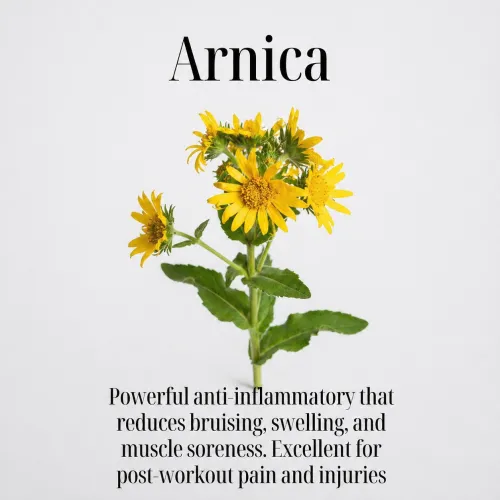
Arnica (Arnica montana) is one of the most well-researched botanical remedies for pain, bruising, and inflammation. Native to the mountain meadows of central Europe, this bright yellow flower has been used in traditional European medicine for centuries to speed recovery from physical trauma, ease sore muscles, and reduce swelling from sprains and strains. Today it remains a cornerstone of natural sports recovery and first-aid formulations.
Key Benefits of Arnica
- Contains helenalin and other sesquiterpene lactones — the active compounds responsible for arnica's potent anti-inflammatory and analgesic activity. (PubMed reference)
- Clinically studied for reducing bruise discoloration and healing time — multiple trials show significant improvement in bruising after surgery, injury, or exercise.
- Powerfully anti-inflammatory topically — helps calm swollen, tender joints, muscle soreness, and post-exertion discomfort.
- Supports faster recovery after athletic performance — widely used by athletes, runners, and physically active individuals.
- Helps ease the discomfort of sprains, strains, and overuse injuries when applied promptly after the incident.
- Traditionally used by European mountain herbalists as the first remedy for falls, knocks, and injuries.
- Works synergistically with other anti-inflammatory botanicals like comfrey, devil's claw, and white willow bark for enhanced effect.
Arnica is used exclusively topically in responsible formulations due to its potency — and in this form it is among the safest, most effective plant-based pain and bruising remedies available. It is a must-have in any natural sports or recovery product.
Traditional Chinese Medicine (TCM) Perspective
While Arnica is a European botanical not found in the classical Chinese pharmacopoeia, its therapeutic actions map precisely onto one of TCM's most important treatment principles: huó xuè huà yū (活血化瘀) — invigorating Blood and transforming Blood stasis.
- TCM Classification: Herbs that invigorate Blood and dispel stasis (活血祛瘀药)
- Nature & Flavor (functional): Warm; Pungent, Bitter
- Meridians Entered (functional): Liver, Heart
- Key TCM Actions: Invigorates Blood, disperses Blood stasis, reduces swelling, relieves pain, promotes healing of traumatic injury.
In TCM, pain after physical trauma — bruising, swelling, sprains — is always understood as the result of Blood stasis: Blood that has left the vessels and pooled in the tissues. The treatment principle is to move and disperse that stagnant Blood. Arnica performs this function with a precision and speed that places it among the most effective topical stasis-resolving substances in any herbal tradition. It is functionally closest to the classical TCM herb San Qi (三七 / Notoginseng), which simultaneously stops bleeding and transforms stasis.
Topical arnica preparations are the evidence-supported route of administration. Clinical trials have used arnica gel concentrations of 20–25% (w/w) arnica tincture equivalent applied 2–3 times daily. Knuesel et al. (2002) demonstrated that 50 g of a 50% arnica tincture-based gel applied over three weeks produced significant reductions in osteoarthritic knee pain comparable to 5% ibuprofen gel. For acute bruising and sports injuries, Pumpa et al. (2014) confirmed meaningful reductions in muscle soreness and recovery time with twice-daily topical application beginning within 24 hours of exertion.
Arnica Post-Training Recovery Salve Application Protocol
- Take a pea-sized to dime-sized amount of arnica salve or gel and warm it briefly between clean fingertips.
- Apply directly to the affected area — bruise, sore muscle, swollen joint, or sprain site — using gentle circular massage strokes for 30–60 seconds until absorbed.
- Repeat 2–3 times daily, ideally after a warm shower when circulation is elevated and skin absorption is optimised.
- Continue application for 3–7 days post-injury or for the duration of training soreness — do not apply to broken or abraded skin.
Research note: Arnica must never be taken internally except in licensed homeopathic micro-dilutions — undiluted arnica tincture or raw plant material is toxic when ingested. Topical use on intact skin is safe and well-tolerated for most people. For best results, apply as soon as possible after injury or intense physical exertion.
Before you use this: Arnica is for external use on intact skin only — do not apply to open wounds, broken skin, mucous membranes, or near the eyes. Individuals with known sensitivity to plants in the Asteraceae (daisy) family — including chamomile, ragweed, and echinacea — may experience allergic contact dermatitis and should perform a patch test before full application. Prolonged or heavy topical use can occasionally cause skin irritation, blistering, or eczematous reactions; discontinue use if redness or irritation develops. Arnica is not recommended for use during pregnancy or while breastfeeding without guidance from a qualified practitioner. The information on this page is for educational purposes only and does not constitute medical advice. Every person's health is unique — before incorporating any herb or botanical into your routine, especially if you are pregnant, nursing, managing a health condition, or taking prescription medications, please consult a qualified integrative health professional.


