
Main page content
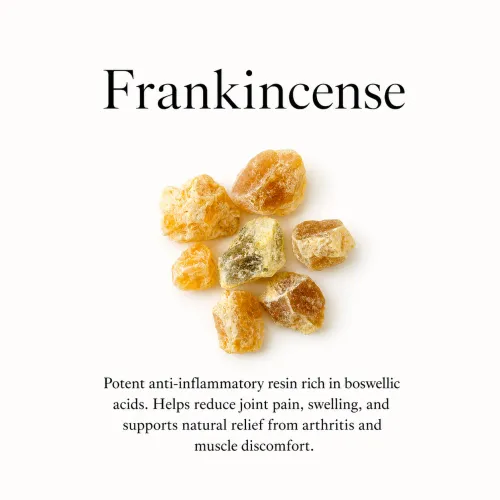
Frankincense (Boswellia sacra, B. carterii, B. serrata) is one of the most ancient and revered substances in human history — traded along incense routes for 5,000 years, burned in temples across every major ancient civilization, and documented in the oldest medical texts from Egypt, Greece, China, and the Middle East. Modern science has validated what traditional healers always knew: frankincense resin contains boswellic acids — among the most potent and selective natural anti-inflammatory compounds discovered in the plant kingdom.
Key Benefits of Frankincense
- Boswellic acids (particularly AKBA — acetyl-keto-beta-boswellic acid) selectively inhibit 5-LOX (5-lipoxygenase), an enzyme central to the production of pro-inflammatory leukotrienes — a mechanism distinct from NSAIDs and with a superior safety profile. (PubMed reference)
- Clinically trialed for osteoarthritis and rheumatoid arthritis — multiple controlled studies show significant pain reduction and improved mobility with boswellia supplementation and topical application.
- Proven to reduce joint space narrowing in arthritis — suggesting it may not only relieve symptoms but actually slow the structural progression of joint disease.
- Rich in alpha-pinene and other terpenes in its essential oil, which carry additional anti-inflammatory and antimicrobial properties to complement the resin's boswellic acid content.
- Its essential oil is one of the most prized in luxury aromatherapy and meditation — the deeply calming, sacred scent has been used for millennia to reduce anxiety and support contemplative states.
- Demonstrates skin-rejuvenating properties — frankincense essential oil is used in premium anti-aging formulations for its ability to tighten skin, reduce the appearance of lines, and support cell regeneration.
- The oldest continuously traded commodity in human history — connecting modern therapeutic use to five thousand years of confirmed, cross-cultural medicinal application.
Frankincense is where ancient wisdom and modern science meet most eloquently. Its anti-inflammatory mechanism is scientifically distinctive, its clinical evidence is among the strongest for any botanical, and its sacred aromatic history gives it a depth of meaning no synthetic compound could replicate.
Traditional Chinese Medicine (TCM) Perspective
Rǔ Xiāng (乳香) — Frankincense resin — is one of the most important herbs in TCM's trauma and pain materia medica. It is almost always paired with Mò Yào (没药 — Myrrh) in classical formulas, the two resins working together to invigorate Blood and move Qi simultaneously.
- Chinese Name: Ru Xiang (乳香) — Frankincense / Olibanum
- Nature & Flavor: Warm; Pungent, Bitter
- Meridians Entered: Heart, Liver, Spleen
- Key TCM Actions: Invigorates Blood and promotes Qi movement, reduces swelling and generates flesh, relieves pain from Blood stasis, benefits tendons and sinews, calms the Spirit.
Ru Xiang is the quintessential "invigorate Blood to stop pain" herb in TCM. Its dual action on both Blood (activating circulation) and Qi (moving stagnation) reflects TCM's core understanding that "Qi is the commander of Blood — where Qi moves, Blood follows." The boswellic acids in frankincense that inhibit 5-LOX inflammation pathways are the biochemical expression of this ancient TCM principle of breaking up Qi and Blood stagnation in painful, swollen tissue.
Boswellia serrata extract standardised to 65 % boswellic acids at 300–500 mg twice daily is among the most consistently validated botanical anti-inflammatories. Gupta et al. (2011) and Sontakke et al. (2007) RCTs showed efficacy comparable to valdecoxib for knee OA. The specific compound AKBA (acetyl-keto-beta-boswellic acid) requires fat for absorption — studies co-administering boswellic acids with a fatty meal showed 4–5× greater bioavailability than fasted dosing.
Boswellic Acid Absorption Protocol
- Take 300–500 mg Boswellia serrata extract (65 % boswellic acids standardised) capsule with the largest meal of the day — always with fat.
- Alternatively, for whole-resin use: chew a pea-sized piece of food-grade frankincense resin (Boswellia carterii or sacra, food-safe grade) for 5–10 minutes after a meal.
- Add ½ tsp turmeric + ¼ tsp black pepper to that same meal for a synergistic anti-inflammatory stack.
Research note: Fasted Boswellia has poor bioavailability; a meal containing at least 10 g fat is the minimum for adequate AKBA absorption (Sterk et al., 2004). Allow 4–8 weeks for full anti-inflammatory effect to accumulate — boswellic acids work through 5-LOX pathway inhibition, which requires sustained serum levels to produce measurable tissue change.
Before you use this: Boswellia supplements vary widely in AKBA content and standardisation — verify the product is tested to '65 % boswellic acids' before purchasing. Some individuals experience mild gastrointestinal upset (nausea, diarrhoea) particularly at the start of supplementation; take with food. Preliminary evidence suggests a mild blood-thinning interaction — avoid combining with anticoagulants without medical supervision. Safety data during pregnancy is insufficient; avoid at therapeutic doses while pregnant. Whole-resin chewing is appropriate only with food-grade resin from a reputable source. The information on this page is for educational purposes only and does not constitute medical advice. Every person's health is unique — before incorporating any herb or botanical into your routine, especially if you are pregnant, nursing, managing a health condition, or taking prescription medications, please consult a qualified integrative health professional.


