
Main page content
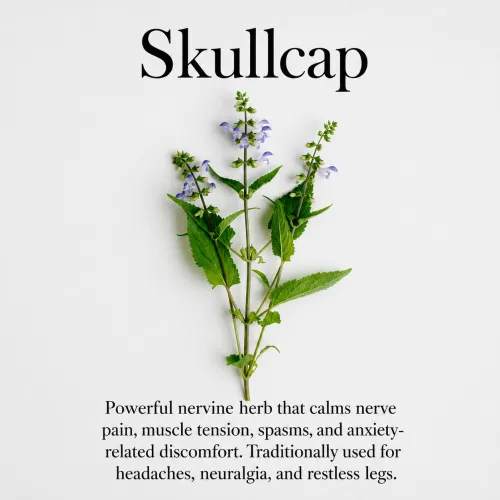
Skullcap (Scutellaria lateriflora, American skullcap) is one of the most important nervine tonics in Western herbal medicine — used for centuries by Eclectic physicians and folk healers to ease nervous tension, anxiety, muscle spasm, and the physical symptoms of stress. Its name refers to the distinctive helmet-shaped calyx of its flowers, and its reputation as a calming, restorative herb for an overstimulated nervous system has proven remarkably durable across changing medical fashions.
Key Benefits of Skullcap
- Contains baicalin, baicalein, and scutellarein — flavonoids with documented anxiolytic, anti-inflammatory, and neuroprotective properties that act on GABAergic pathways to reduce anxiety without sedation. (PubMed reference)
- Clinical studies show significant reductions in anxiety scores with skullcap supplementation — with mood enhancement and maintained cognitive performance (no impairment of alertness).
- Baicalein demonstrates potent antioxidant and anti-inflammatory activity — inhibiting COX-2, LOX, and NF-κB inflammatory pathways with results comparable to pharmaceutical NSAIDs in vitro.
- A premier nervous system restorative — not just a sedative, but a trophorestorative that strengthens and nourishes depleted nervous tissue over time with consistent use.
- Traditionally used for muscle spasm, tension headaches, and nervous tremors — skullcap's antispasmodic properties complement its nervine action to address the physical manifestations of nervous system excess.
- Works beautifully with valerian and cramp bark in compound formulations — the three together address anxiety, sleep disruption, and physical muscle tension comprehensively.
- Honored by 19th-century Eclectic physicians as one of their most reliable herbs for what they called "nervous exhaustion" — the depleted, over-wound state that resonates strongly with modern stress and burnout.
Skullcap is the healer's answer to a nervous system pulled too tight for too long — not numbing or suppressing, but genuinely nourishing and restoring the tissues that anxiety and chronic stress wear thin. It is one of the most quietly important herbs in the natural medicine cabinet.
Traditional Chinese Medicine (TCM) Perspective
While North American Skullcap (Scutellaria lateriflora) differs from classical Chinese Skullcap, its TCM relative Huáng Qín (黄芩 — Scutellaria baicalensis) is one of the top 50 fundamental herbs in Chinese medicine, making the skullcap genus among the most medicinally significant plant families in the TCM pharmacopoeia.
- Chinese Name (TCM relative): Huang Qin (黄芩) — Chinese Skullcap / Baikal Skullcap
- Nature & Flavor: Cold; Bitter
- Meridians Entered: Lung, Gallbladder, Stomach, Large Intestine
- Key TCM Actions: Clears Heat and dries Damp (the primary action), drains Fire and resolves toxicity, stops bleeding (by cooling Blood Heat), calms the fetus (by clearing Liver-Gallbladder Heat), and — for North American skullcap specifically — calms the Liver and extinguishes Wind, sedates the Spirit.
North American skullcap's primary indication — calming anxiety, nervous exhaustion, and muscle tension — aligns most closely with TCM's "Liver Wind" and "Heart Shen disturbance" patterns. Its baicalin content (shared with Huang Qin) provides the GABA-modulating action that TCM would describe as "sedating Liver Fire and extinguishing Wind to calm the disturbed Spirit." In chronic stress and nervous system overactivation, this Wind-calming action is the primary therapeutic mechanism.
Brock et al. (2014) double-blind crossover RCT: 350 mg American skullcap extract twice daily (700 mg total, standardised) significantly enhanced global mood and alertness without sedation. Wolfson & Hoffmann (2003) showed anxiolytic effects via GABA-A receptor modulation. Tea brewed from 1–2 tsp dried herb delivers approximately 200–400 mg total extract equivalent per cup, within the lower effective range.
Nervine Skullcap Tea
- 1–2 tsp dried skullcap herb (500 mg–1 g) in 250 ml water at 90 °C.
- Steep 10–15 minutes, covered — the flavonoids baicalin and scutellarein require extended steeping for adequate extraction.
- Add raw honey + lemon balm (equal part) for a synergistic nervine blend.
- Drink 1–3 cups/day for ongoing anxiety support, or 1 cup in the evening for sleep.
Research note: Skullcap quality varies enormously between suppliers — adulteration with germander (Teucrium species, hepatotoxic) has been documented historically. Purchase only from reputable herb suppliers with third-party testing. Effects are cumulative over 2–4 weeks. Do not combine with alcohol, benzodiazepines, or other GABAergic sedatives — additive CNS depression is possible.
Before you use this: Adulteration risk: Skullcap has historically been adulterated with germander (Teucrium species), which is hepatotoxic. Purchase only from suppliers who provide third-party testing confirming species identity. Skullcap has additive CNS-depressant effects with alcohol, benzodiazepines, opioids, and other sedative medications — do not combine. Do not drive or operate machinery shortly after consuming. Avoid during pregnancy. If you experience jaundice, dark urine, or unusual fatigue while using skullcap, discontinue immediately and seek medical evaluation. The information on this page is for educational purposes only and does not constitute medical advice. Every person's health is unique — before incorporating any herb or botanical into your routine, especially if you are pregnant, nursing, managing a health condition, or taking prescription medications, please consult a qualified integrative health professional.


