
Main page content
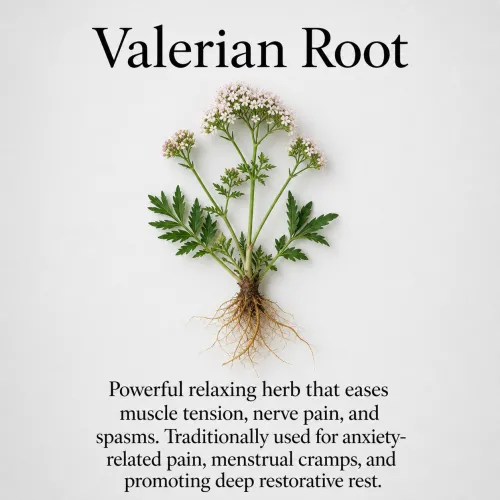
Valerian root (Valeriana officinalis) has been the primary botanical remedy for sleep and anxiety in Western herbal medicine since at least the time of ancient Greece and Rome, where physicians prescribed it for insomnia, nervous conditions, and heart palpitations. Its efficacy has survived the test of time and modern scientific scrutiny alike — multiple clinical trials confirm that valerian significantly improves sleep quality, reduces time to fall asleep, and eases anxiety without the dependence or morning grogginess associated with pharmaceutical sedatives.
Key Benefits of Valerian Root
- Contains valerenic acid, valerenol, and isovaleric acid — compounds that modulate GABA (gamma-aminobutyric acid) receptors in the brain, producing genuine anxiolytic and sedative effects without creating physical dependence. (PubMed reference)
- Multiple meta-analyses and clinical trials confirm that valerian significantly improves sleep quality, reduces sleep latency (time to fall asleep), and increases deep sleep duration in adults.
- Approved in Germany (Commission E) and other European countries as an over-the-counter remedy for sleep disturbance and nervous tension — one of the most clinically validated sleep botanicals.
- A potent muscle relaxant — valerian's isovaleric acid acts on smooth and skeletal muscle to reduce tension, spasm, and the physical tightness associated with stress.
- Works beautifully with skullcap, cramp bark, and passionflower in compound formulations addressing both the nervous and muscular components of tension and poor sleep.
- Used in Ayurvedic (Tagar) and Chinese (Xie Cao) medicine for calming Vata disorders, anxiety, and conditions of excess nervous energy — its application spans the great medical traditions of East and West.
- The distinctive earthy, slightly pungent aroma of valerian root is a familiar landmark in serious herbal preparations — a sensory signal of genuine medicinal strength.
Valerian is one of the oldest, most trusted, and most clinically credible sleep and anxiety botanicals in the world. For the body wound too tight to rest, it offers something genuinely remarkable: deep, natural relaxation without the dulling burden of pharmaceutical sedation.
Traditional Chinese Medicine (TCM) Perspective
Valerian (Xié Cǎo, 缬草) has been used in Chinese medicine and corresponds functionally to the category of substances that calm the Heart Spirit, anchor restless Yang, and promote restful sleep. It parallels the actions of classical TCM sedative herbs like Suān Zǎo Rén (酸枣仁 — Sour Jujube Seed) and Yuǎn Zhì (远志 — Polygala).
- Chinese Name: Xie Cao (缬草) — Valerian
- Nature & Flavor: Warm; Pungent, slightly Bitter
- Meridians Entered: Heart, Liver
- Key TCM Actions: Calms the Heart and anchors the Spirit, relieves insomnia and anxiety, relieves pain and relaxes spasm, invigorates Blood (mild), dispels Wind.
In TCM's sleep medicine, insomnia is understood through the organ systems: inability to fall asleep suggests Heart Fire or Liver Qi constraint; difficulty staying asleep suggests Heart-Kidney Yin deficiency; waking with anxiety suggests Gallbladder Qi deficiency. Valerian most closely addresses the Heart Fire and Liver Qi constraint types — its warming, sedating, antispasmodic action directly calms the overactivated Liver-Heart axis that prevents the Spirit from "resting in the Blood" during sleep.
Bent et al. (2006) meta-analysis of 16 studies: 300–600 mg standardised valerian extract (0.8 % valerenic acid) reduced sleep onset time by 15–20 minutes and improved sleep quality without morning grogginess. Donath et al. (2000) RCT confirmed benefit after 14 days' consistent use — single doses show minimal effect. Dried herb tea at 3–5 g per cup delivers approximately 100–200 mg valerenic acid equivalent.
Valerian Root Sleep Tea
- 3–5 g dried valerian root (1–1.5 tsp) in 250 ml water at 90 °C.
- Steep 10–15 minutes, covered — prevents volatile sesquiterpenes from escaping.
- Strain thoroughly (valerian sediment is intensely bitter).
- Mix with 1 tsp honey + chamomile (equal part) to offset the distinctive smell.
- Drink 30–45 minutes before bed. Use consistently for at least 2–4 weeks.
Research note: Valerian's characteristic strong odour (isovaleric acid) is inseparable from its therapeutic compounds — deodorised preparations have reduced potency. The effect is not acute; it accumulates over 2–4 weeks of nightly use. Do not judge based on the first night. Take in 4–6 week courses with 1–2 week breaks. Do not combine with alcohol, benzodiazepines, or barbiturates. The FDA classifies valerian as "generally recognised as safe" (GRAS) for use as a food supplement.
Before you use this: Valerian has additive CNS-depressant effects with alcohol, benzodiazepines, barbiturates, and sleep medications — do not combine. Do not drive or operate heavy machinery in the hours after consuming valerian tea. Discontinue valerian at least two weeks before elective surgery — it may potentiate anaesthesia. A small proportion of people experience a paradoxical stimulant effect from valerian (increased alertness, vivid dreams); if this occurs, morning use may suit you better than evening. Avoid during pregnancy. Long-term continuous use beyond 6 weeks is not well studied; take a 1–2 week break between courses. The information on this page is for educational purposes only and does not constitute medical advice. Every person's health is unique — before incorporating any herb or botanical into your routine, especially if you are pregnant, nursing, managing a health condition, or taking prescription medications, please consult a qualified integrative health professional.


