
Main page content
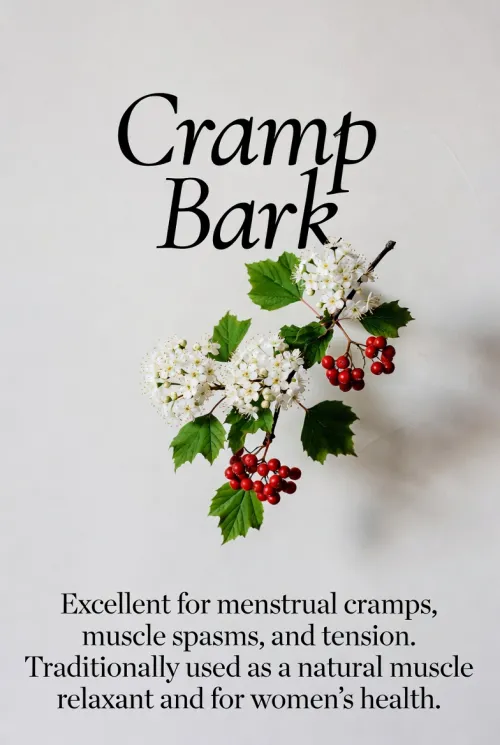
Cramp bark (Viburnum opulus) is one of the most respected and widely used muscle-relaxant botanicals in Western herbalism. As its name plainly declares, this beautiful hedgerow shrub has been used across Europe and North America for centuries to ease muscular cramps, spasms, and tension — from uterine cramps to tight back muscles to leg cramps. Its active compounds work directly on smooth and skeletal muscle to reduce excessive tone and promote natural relaxation.
Key Benefits of Cramp Bark
- Contains viopudial, scopoletin, and isovalerianic acid — compounds that directly relax smooth and skeletal muscle by reducing calcium-mediated muscle contraction. (PubMed reference)
- One of the most effective natural antispasmodic herbs — traditionally prescribed by herbalists for menstrual cramps, intestinal spasms, back muscle tension, and leg cramps.
- Works at the nerve-muscle junction to reduce excessive nerve firing that drives sustained muscle spasm and cramping.
- Provides genuine anti-inflammatory action alongside its antispasmodic effect — reducing both the pain and the inflammatory component of muscle injury.
- Used in Native American and European folk medicine as a key remedy for any condition involving muscular over-contraction or spasm.
- Works synergistically with valerian root and skullcap — creating compound formulations that address both the muscular and nervous system components of tension and cramping.
- Traditionally used by women healers as one of the primary women's herbs for relieving dysmenorrhea (painful menstruation) and uterine tension.
Cramp bark is nature's direct answer to muscle tension — not masking pain through numbing, but actually addressing the underlying over-contraction that causes it. In skilled hands and formulas, it delivers genuine, targeted relief that complements and extends the action of other analgesic botanicals.
Traditional Chinese Medicine (TCM) Perspective
While Cramp Bark (Viburnum opulus) is not in the classical Chinese pharmacopoeia, its primary action — relaxing smooth and skeletal muscle spasm — maps directly onto TCM's principle of "relaxing sinews and unblocking the channels" (shū jīn tōng luò, 舒筋通络).
- TCM Classification: Herbs that relax sinews, free the channels, and relieve pain
- Nature & Flavor (functional): Cool; Bitter, slightly Sour
- Meridians Entered (functional): Liver, Uterus
- Key TCM Actions: Relaxes sinews and muscles, unblocks the channels, relieves spasm and cramping pain, soothes the Liver (which "governs the sinews"), regulates the Chong and Ren meridians for uterine spasm.
In TCM, muscle cramps and spasms are understood as Liver-governed sinews that have lost their nourishment (Blood deficiency) or are obstructed by Cold or tension. Cramp Bark's antispasmodic action would be understood as simultaneously nourishing Liver Blood and releasing channel obstruction — the two-pronged approach TCM uses for all musculoskeletal cramping conditions.
Commission E (Germany) and the British Herbal Pharmacopoeia recognise 2–4 g dried cramp bark per cup, 3× daily as the established dose for uterine and smooth-muscle cramps. The active scopoletin and viopudial compounds require a full 15-minute steep for adequate extraction. Human RCT data is limited, but centuries of consistent clinical herbalist documentation supports its antispasmodic action.
Cramp Bark Antispasmodic Tea
- 2–4 g dried cramp bark (1 heaped tsp) in 250 ml cold water.
- Bring to boil, reduce heat, simmer 10–15 minutes.
- Strain and drink warm.
- Drink up to 3 cups/day during the acute phase; reduce to 1 cup/day for prevention.
Research note: Simple steeping in hot water is insufficient — cramp bark's active compounds require a light decoction (simmering) for full extraction. Tincture form (1:5 in 45 % alcohol) at 4–8 ml three times daily delivers more consistent active-compound levels than tea. Avoid during the first trimester of pregnancy.
Before you use this: Avoid cramp bark during the first trimester of pregnancy — it has a documented antispasmodic effect on uterine smooth muscle, which is its therapeutic action but also its key obstetric risk. Safety data for use beyond 8 consecutive weeks is limited; take periodic breaks. Not well studied during breastfeeding. May enhance the effects of other smooth-muscle-relaxing medications. If pelvic or abdominal pain persists or worsens, seek medical evaluation before continuing. The information on this page is for educational purposes only and does not constitute medical advice. Every person's health is unique — before incorporating any herb or botanical into your routine, especially if you are pregnant, nursing, managing a health condition, or taking prescription medications, please consult a qualified integrative health professional.


