
Main page content
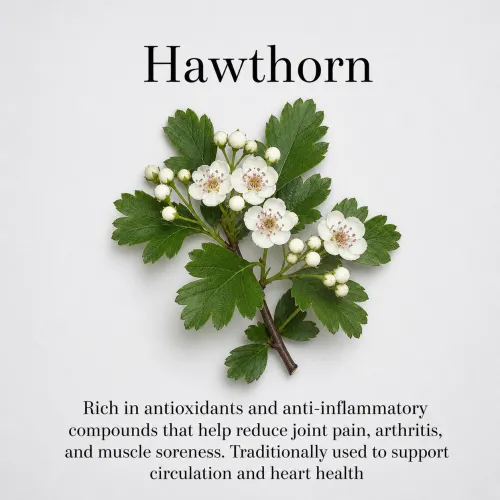
Hawthorn (Crataegus monogyna, C. laevigata) is one of Europe's oldest and most revered medicinal plants — a spiny hedgerow tree whose berries, leaves, and flowers have been used in herbal medicine for centuries to support cardiovascular health, circulation, and resilience. Its berries are among the most antioxidant-rich fruits in the European botanical landscape, and its active oligomeric proanthocyanidins (OPCs) are among the most studied natural cardiovascular compounds in the world.
Key Benefits of Hawthorn
- Rich in oligomeric proanthocyanidins (OPCs) and flavonoids — compounds with documented ability to strengthen capillary walls, improve peripheral circulation, and protect blood vessels from oxidative damage. (PubMed reference)
- Supports peripheral microcirculation — improved blood flow to extremities and surface tissues helps deliver oxygen and nutrients to muscles, joints, and skin.
- Demonstrates potent antioxidant activity — hawthorn OPCs are among the strongest free-radical scavengers found in commonly used botanical ingredients.
- Traditionally used in Western and Chinese herbal medicine to tonify the heart, improve circulation, and support physical endurance — a centuries-old botanical for active bodies.
- Anti-inflammatory action through COX enzyme inhibition — hawthorn flavonoids reduce inflammatory mediators while simultaneously supporting circulatory health.
- The deep red hawthorn berry brings natural color, astringency, and a tart, complex flavor profile to botanical formulations.
- Traditionally seen as the guardian of heart health and longevity — planted at boundaries and sacred sites across Europe as a protective, life-giving tree.
Hawthorn is the botanical of the heart in every sense — physically supporting circulation and cardiovascular resilience, and traditionally associated with protection, boundary-keeping, and enduring strength. In topical formulations, its circulatory and antioxidant benefits extend naturally to skin and muscle tissue.
Traditional Chinese Medicine (TCM) Perspective
Shān Zhā (山楂) — Hawthorn Berry — is one of TCM's most important digestive herbs and a significant cardiovascular tonic. It is among the 50 fundamental herbs of classical Chinese medicine and appears in essential modern formulas for heart health.
- Chinese Name: Shan Zha (山楂) — Hawthorn Berry
- Nature & Flavor: Slightly warm; Sour, Sweet
- Meridians Entered: Spleen, Stomach, Liver
- Key TCM Actions: Reduces food stagnation (especially meat and fatty foods), transforms Blood stasis, invigorates Blood and disperses clumps, stops diarrhea, reduces hyperlipidemia.
Hawthorn occupies a unique position in TCM because it simultaneously benefits the digestive center (Spleen-Stomach food stagnation) and the cardiovascular system (Liver Blood stasis). Modern TCM research has validated its use for coronary artery disease, hypertension, and dyslipidemia — all conditions of Blood stasis and Phlegm accumulation in TCM's framework. Its sour flavor also has a special affinity for the Liver in five-phase theory, where it gently regulates and softens Liver constraint.
The Pittler et al. Cochrane meta-analysis (2008) of 14 RCTs confirms 160–900 mg standardised hawthorn extract (3–5 % oligomeric procyanidins) daily significantly improves exercise tolerance and reduces fatigue in mild-to-moderate heart failure. Two cups of hawthorn berry decoction from 3 g berry deliver approximately 200–300 mg OPCs — within the lower effective range. The berries require a full decoction (simmering), not steeping.
Hawthorn Berry Heart Decoction
- 3 g dried hawthorn berries (approximately 2 heaped tsp) in 300 ml cold water.
- Bring to boil, reduce to low simmer, cook 10–15 minutes.
- Add 1 cinnamon stick for the last 5 minutes.
- Strain. Drink 2 cups/day, consistently, for minimum 8 weeks.
Research note: Hawthorn's cardiovascular benefit is cumulative and requires consistent daily use for 8–12 weeks before measurable effect on exercise capacity. Single doses have no acute effect. Hawthorn can potentiate digoxin and other cardiac glycosides — consult a prescribing physician before use if on cardiac medications.
Before you use this: Important: Hawthorn can potentiate digoxin and other cardiac glycosides — if you take any heart medication, medical supervision is required before adding hawthorn. It may also enhance the blood-pressure-lowering effect of antihypertensives, potentially causing hypotension. Do not use hawthorn as a replacement for prescribed cardiac medications. If you experience chest pain, palpitations, shortness of breath, or swelling of the ankles, seek immediate medical evaluation — these symptoms require diagnosis before any herbal self-management. The information on this page is for educational purposes only and does not constitute medical advice. Every person's health is unique — before incorporating any herb or botanical into your routine, especially if you are pregnant, nursing, managing a health condition, or taking prescription medications, please consult a qualified integrative health professional.


