
Main page content
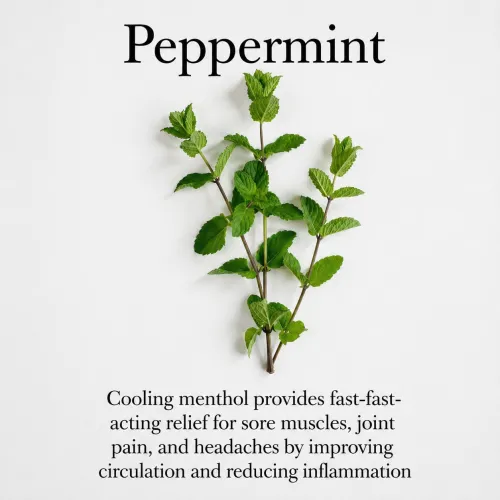
Peppermint (Mentha piperita) is one of the most widely used medicinal plants on Earth — and one of the most immediately recognizable. Its essential oil, rich in menthol and menthone, delivers a powerful cooling, analgesic, and antimicrobial action that has been relied upon across virtually every traditional medicine system in the Northern Hemisphere. Whether cooling inflamed joints, clearing congested airways, or awakening a fatigued mind, peppermint performs with reliable, consistent therapeutic power.
Key Benefits of Peppermint
- Menthol — peppermint's signature compound — activates TRPM8 cold receptors in the skin, producing an immediate, lasting cooling and analgesic sensation without lowering actual tissue temperature. (PubMed reference)
- Clinically validated for tension headache relief — topical peppermint oil applied to the forehead and temples reduces headache intensity as effectively as paracetamol in controlled studies.
- Demonstrated anti-inflammatory activity — inhibits prostaglandin biosynthesis and reduces inflammatory markers in both in vitro and in vivo studies.
- Among the strongest natural antimicrobials — peppermint oil is effective against bacteria, fungi, and viruses including Herpes simplex, MRSA, and many common skin pathogens.
- The cooling sensation provides immediate relief from muscle soreness and post-exercise discomfort — a staple in sports recovery products worldwide.
- In aromatherapy, peppermint is the premier mental energizer and focus enhancer — inhaling peppermint oil increases alertness, reduces mental fatigue, and improves memory performance in multiple studies.
- Provides a beautiful cooling counterpoint to warming botanicals like cayenne, ginger, and cinnamon in compound pain formulations — the hot-cold duality creating more complete analgesic coverage.
Peppermint is the botanical of immediate, unmistakable action — cooling, clarifying, and powerfully therapeutic. Its combination of menthol-driven pain relief, strong antimicrobial activity, and extraordinary aromatic clarity makes it one of the most indispensable and beloved botanicals in natural medicine.
Traditional Chinese Medicine (TCM) Perspective
Bò Hé (薄荷) — Peppermint — is one of TCM's most important Wind-Heat releasing herbs and appears in dozens of classical formulas for febrile conditions, throat inflammation, and Liver Qi constraint. It is simultaneously a Surface-releasing herb and a Liver-soothing herb, a combination unique among TCM's aromatic medicines.
- Chinese Name: Bo He (薄荷) — Peppermint / Field Mint
- Nature & Flavor: Cool; Pungent
- Meridians Entered: Lung, Liver
- Key TCM Actions: Disperses Wind-Heat from the Exterior, benefits the throat, clears the head and eyes, vents skin eruptions (measles, rashes), soothes Liver Qi stagnation and relieves chest and flank distension.
Bo He occupies a rare dual position in the TCM pharmacopoeia: it is the only major Wind-Heat herb that also enters the Liver meridian to soothe Qi stagnation. This makes it essential in formulas addressing both the physical (fever, sore throat) and emotional (stress, irritability, headache from Liver Yang rising) aspects of disease simultaneously. Applied topically, menthol activates cold receptors (TRPM8) in a way TCM describes as "dispersing Wind-Heat and opening the orifices of the skin."
Ford et al. (2008) Cochrane meta-analysis: peppermint oil (0.2–0.4 ml enteric-coated capsules) 3× daily is the most consistently effective IBS intervention studied. For tea: Pittler & Ernst (1998) confirmed therapeutic benefit at 1–2 tsp dried leaf per cup, 3 cups/day. The single most impactful preparation variable is the lid — menthol evaporates at room temperature and accelerates dramatically with steam; a covered 10-minute steep retains up to 4× more menthol than uncovered.
Covered Peppermint Tea
- 1–2 tsp dried peppermint leaf (or 4–5 fresh leaves) in 200 ml just-boiled water.
- Cover immediately with a saucer or lid.
- Steep exactly 10 minutes — no more (bitterness increases, menthol fraction decreases after 10 min).
- Drink 3 cups/day, ideally 15–20 minutes before meals.
Research note: Enteric-coated peppermint oil capsules (Colpermin, Mintec) deliver menthol directly to the intestine, bypassing upper-GI reflux — they are clinically more potent than tea for IBS. Tea is superior for upper-GI symptoms (nausea, indigestion, tension headache). Do not give peppermint to infants or young children — menthol can cause respiratory distress. Those with GERD should use with caution; peppermint relaxes the lower oesophageal sphincter and may worsen reflux.
Before you use this: Peppermint relaxes the lower oesophageal sphincter — it is contraindicated in gastro-oesophageal reflux disease (GERD) and hiatus hernia, where this relaxation worsens reflux symptoms. Do not give peppermint tea or peppermint oil to infants or young children — menthol can cause laryngospasm and respiratory depression. Enteric-coated peppermint oil capsules should not be broken or chewed — they are designed to bypass the stomach; opening them causes intense heartburn. Do not apply peppermint oil directly to the face of children under two. The information on this page is for educational purposes only and does not constitute medical advice. Every person's health is unique — before incorporating any herb or botanical into your routine, especially if you are pregnant, nursing, managing a health condition, or taking prescription medications, please consult a qualified integrative health professional.


