
Main page content
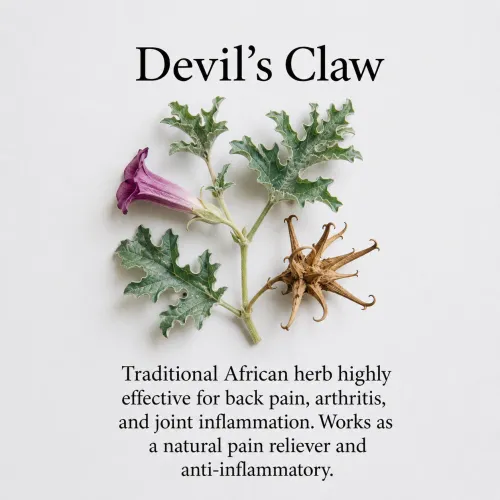
Devil's claw (Harpagophytum procumbens) is a remarkable medicinal plant native to the Kalahari Desert of southern Africa. Its dramatically hooked fruits — the origin of its memorable name — belie the extraordinary anti-inflammatory and analgesic power concentrated in its roots. Used for centuries by Khoisan and San peoples for fever, pain, and digestive complaints, devil's claw is now one of the most clinically studied botanical remedies for arthritis and musculoskeletal pain in the world.
Key Benefits of Devil's Claw
- Contains harpagoside and harpagide — iridoid glycosides demonstrated in multiple clinical trials to reduce joint pain and inflammation comparably to prescription NSAIDs for osteoarthritis patients. (PubMed reference)
- Approved by German Commission E and ESCOP (European Scientific Cooperative on Phytotherapy) for the treatment of painful osteoarthritis and lower back pain.
- Inhibits COX-2 and LOX inflammatory enzymes — the same pathways targeted by many pharmaceutical NSAIDs, but through plant-based compounds with a better safety profile.
- Clinical studies show significant improvement in hip, knee, and spinal joint pain with consistent use — with benefits accumulating over 4–12 weeks.
- Traditional African medicine used devil's claw as a primary remedy for "joint fever" and degenerative joint conditions — modern research has fully validated this traditional application.
- Works synergistically with other anti-inflammatory botanicals — turmeric, boswellia, and white willow bark — in compound joint and pain formulas.
- Demonstrates antioxidant activity that may protect cartilage and joint tissue from ongoing oxidative damage alongside its acute pain-relieving action.
Devil's claw is one of the great botanical success stories — a traditional African remedy that has survived rigorous clinical scrutiny and emerged as a genuinely evidence-based natural alternative to pharmaceutical pain management for arthritis and back pain.
Traditional Chinese Medicine (TCM) Perspective
Devil's Claw (Harpagophytum procumbens) is an African botanical increasingly integrated into modern Chinese herbal practice for its potent anti-inflammatory and analgesic effects on musculoskeletal conditions — exactly the domain of TCM's Bi syndrome herbs.
- TCM Classification: Herbs that dispel Wind-Damp, free the channels, and relieve Bi syndrome pain
- Nature & Flavor (functional): Cool; Bitter
- Meridians Entered (functional): Liver, Kidney
- Key TCM Actions: Dispels Wind-Damp-Heat, frees the channels and collaterals, relieves Bi syndrome (joint and muscle pain), reduces swelling, clears Heat from the sinews and joints.
In TCM's classification of painful obstruction, Devil's Claw most closely resembles Rè Bì (热痹 — Hot Bi syndrome) herbs: those used when joint inflammation presents with heat, redness, and swelling, as in rheumatoid arthritis flares. Its harpagoside compounds inhibit multiple inflammatory cytokines simultaneously — a pharmacological profile that TCM would recognize as "clearing Fire toxins from the channels and resolving Damp-Heat accumulation in the joints."
Chrubasik et al. (1996) and the Gagnier et al. (2004) systematic review confirm 50–100 mg harpagoside/day (the marker compound) significantly reduces chronic low back pain and osteoarthritis pain — effect sizes comparable to NSAIDs in some comparisons. This equates to approximately 4.5 g dried root/day of a typical preparation, or standardised extract at 2 × 200 mg capsules providing 50 mg harpagoside total.
Cold-Decoction Devil's Claw Tea
- 4.5 g dried devil's claw root in 500 ml cold water in a glass jar.
- Soak refrigerated for 8 hours (overnight) — cold infusion preserves significantly more harpagoside than hot water extraction.
- Strain, warm gently if desired, divide into 2–3 portions, and drink throughout the day with meals.
Research note: Harpagoside is unstable above 70 °C; hot decoction destroys a meaningful fraction of the active compound. The overnight cold-infusion method is validated by Wegener & Lüpke (2003) as preserving ~40 % more harpagoside than boiling. Take with food — devil's claw stimulates stomach acid and can cause GI distress when taken fasting. Allow 4–8 weeks for measurable pain reduction.
Before you use this: Devil's claw stimulates gastric acid secretion — it must be taken with food, never fasting, and is contraindicated in active peptic ulcers or gastro-oesophageal disease. Avoid in gallstones and cardiac arrhythmias. May interact with anticoagulants (warfarin) and antihypertensive medications. Avoid during pregnancy — traditional classification as a uterine stimulant is supported by preliminary evidence. Allow 4–8 weeks for measurable therapeutic effect before concluding it is not working; do not abruptly discontinue pain medications while trialling. The information on this page is for educational purposes only and does not constitute medical advice. Every person's health is unique — before incorporating any herb or botanical into your routine, especially if you are pregnant, nursing, managing a health condition, or taking prescription medications, please consult a qualified integrative health professional.


