
Main page content
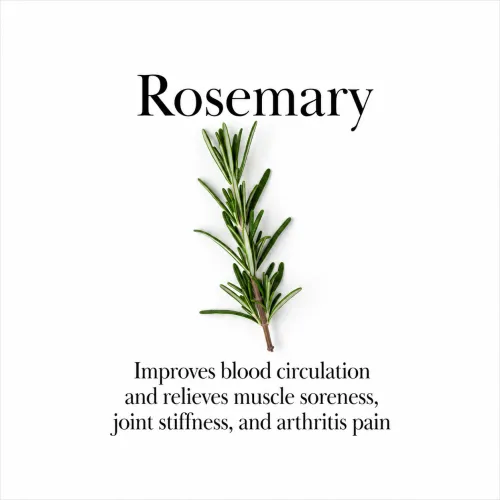
Rosemary (Salvia rosmarinus, formerly Rosmarinus officinalis) is one of the most versatile and well-studied Mediterranean herbs — used continuously in medicine, cooking, and ritual across Greece, Rome, and the Arab world for over 2,000 years. Its aromatic branches were burned to purify air, its leaves made into medicines for digestion, pain, and memory, and its oil is now one of the most extensively researched botanical ingredients for circulation, pain relief, and cognitive support.
Key Benefits of Rosemary
- Rich in rosmarinic acid and carnosic acid — phenolic diterpenes with documented antioxidant, anti-inflammatory, and neuroprotective properties that consistently place rosemary among the highest-ORAC botanicals. (PubMed reference)
- Powerfully stimulates scalp circulation — multiple studies confirm rosemary oil is as effective as minoxidil (Rogaine) for androgenic alopecia, significantly increasing hair count after 6 months of use.
- Provides warming analgesic relief for muscle and joint pain — rosemary's camphor, cineole, and camphene content creates a warming, anti-inflammatory effect on applied tissues.
- In aromatherapy, rosemary is the premier mental energizer and memory enhancer — multiple human studies confirm improved alertness, cognitive speed, and memory with rosemary inhalation.
- Demonstrated antimicrobial and antifungal activity — rosemary extracts are active against a broad range of skin-relevant pathogens.
- A powerful natural preservative — rosemary extract (RE) is one of the most effective and widely used natural antioxidant preservatives in clean beauty formulation.
- Carries the ancient Mediterranean symbolism of remembrance, vitality, and loyalty — the herb of memory, healing, and enduring presence.
Rosemary is the quintessential Mediterranean healing herb — energizing, protecting, preserving, and deeply invigorating in every application. Its breadth of validated benefits, from hair regrowth to cognitive support to pain relief, makes it one of the most complete and indispensable botanicals in natural medicine.
Traditional Chinese Medicine (TCM) Perspective
Mí Dié Xiāng (迷迭香) — Rosemary — has been formally incorporated into modern Chinese herbal medicine for its invigorating, channel-opening, and Yang-supporting properties. It is classified among herbs that activate Blood circulation, dispel Wind-Cold, and clear the head.
- Chinese Name: Mi Die Xiang (迷迭香) — Rosemary
- Nature & Flavor: Warm; Pungent, slightly Bitter
- Meridians Entered: Liver, Heart
- Key TCM Actions: Invigorates Blood and promotes circulation, dispels Wind-Cold, clears the head and benefits mental clarity, strengthens Heart Yang, opens the channels and collaterals, stimulates hair growth through scalp Blood invigoration.
Rosemary's demonstrated effectiveness for hair regrowth (comparable to minoxidil in clinical trials) corresponds directly to a core TCM principle: healthy hair growth requires abundant Kidney Essence (Jing) and Liver Blood flowing freely to the scalp. Where there is Blood stagnation in the scalp's channels, hair thins and falls. Rosemary's Blood-invigorating action "opens the channels" of the scalp, restoring the flow of nourishing Blood and Essence to the hair follicles — a purely TCM-consistent explanation for its clinically validated action.
Kennedy et al. (2016) RCT: 750 mg rosemary leaf extract significantly improved memory speed and quality-of-memory ratings in healthy older adults. Moss et al. (2012) demonstrated cognitive enhancement from ambient rosemary aroma. For cardiovascular: 1 g dried rosemary provides ~100 mg rosmarinic acid, the concentration associated with anti-inflammatory effects in multiple studies. Cold infusion preserves rosmarinic acid fully; hot tea additionally releases volatile terpenes (cineole, camphor) that drive the cognitive benefit through olfactory stimulation.
Rosemary Cognitive Infusion
- 2–3 fresh rosemary sprigs (or 1 tsp dried = ~1 g) in 1 L cold water with 1 lemon slice.
- Refrigerate for 4–8 hours (cold infusion). Drink throughout the day.
- Or for hot tea: steep 1 tsp dried rosemary in 250 ml water at 90 °C for 5–7 minutes, covered. Drink 2 cups/day.
Research note: The hot tea also provides aromatherapeutic benefit through inhalation while drinking — hold the cup near your face and breathe in the steam for 30–60 seconds before each sip. Do not exceed 4 g/day dried rosemary as a medicinal supplement — epileptogenic effects have been reported at very high doses. Safe as a culinary herb in food quantities without restriction.
Before you use this: Avoid therapeutic supplemental doses of rosemary during pregnancy — rosemary stimulates uterine circulation and has been used traditionally as an emmenagogue; culinary cooking amounts are safe. At supplemental doses above 4 g/day, rosemary's camphor content has documented epileptogenic potential — do not supplement beyond the tea doses described here. Rosemary may mildly reduce the effectiveness of ACE inhibitors and diuretic medications. Those with epilepsy should avoid concentrated rosemary oil and high-dose extracts. The information on this page is for educational purposes only and does not constitute medical advice. Every person's health is unique — before incorporating any herb or botanical into your routine, especially if you are pregnant, nursing, managing a health condition, or taking prescription medications, please consult a qualified integrative health professional.


