
Main page content
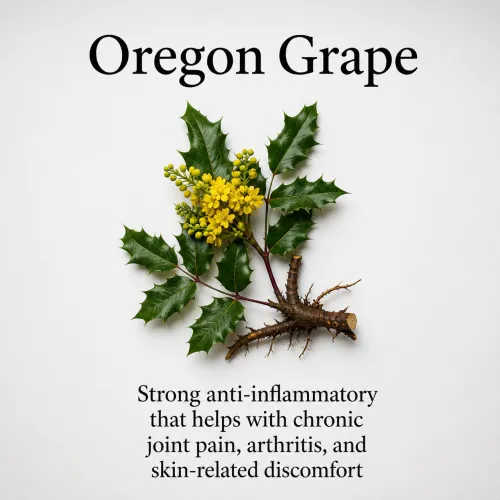
Oregon grape root (Mahonia aquifolium) is a striking Pacific Northwest native shrub whose bright yellow inner bark and root have been used medicinally by Indigenous peoples of the Pacific Coast for thousands of years. Its primary bioactive compound — berberine — is one of the most extensively studied plant alkaloids in modern pharmacology, with a research record spanning antimicrobial, anti-inflammatory, and skin-specific applications. Oregon grape root is particularly notable for its clinically validated effectiveness in chronic skin conditions like psoriasis.
Key Benefits of Oregon Grape Root
- Berberine — Oregon grape's primary alkaloid — demonstrates potent antimicrobial activity against bacteria, fungi, and many parasites, and is one of the most studied plant compounds for skin health and inflammatory skin conditions. (PubMed reference)
- Clinically trialed for psoriasis treatment — topical applications of Mahonia aquifolium extract show significant improvement in psoriatic plaques, with a safety profile superior to many pharmaceutical options.
- Inhibits keratinocyte proliferation — the mechanism behind psoriasis plaques — through berberine's action on cell division signaling pathways.
- Powerful anti-inflammatory action — inhibits multiple inflammatory pathways including NF-κB and COX enzymes, addressing both acute and chronic skin inflammation.
- A strong natural antifungal and antibacterial agent — used topically for candida infections, impetigo, and other skin infections in traditional Pacific Northwest medicine.
- Used by Native American healers as a primary skin remedy — the Salish, Nez Perce, and other Pacific Coast peoples applied it for virtually every skin condition from eczema to wounds to rashes.
- Berberine's bright yellow color in formulations reflects its alkaloid content — this striking pigment was also historically used as a natural dye.
Oregon grape root is one of North America's most powerful skin botanicals — a plant whose traditional uses are now supported by clinical evidence at the level of pharmaceutical standards. Its berberine-rich profile makes it uniquely effective for inflammatory and infectious skin conditions alike.
Traditional Chinese Medicine (TCM) Perspective
Oregon Grape Root's high berberine content places it functionally alongside TCM's berberine-rich herbs: Huáng Lián (黄连 — Coptis), Huáng Bǎi (黄柏 — Phellodendron), and Huáng Qín (黄芩 — Scutellaria). These herbs share the same core actions in TCM.
- TCM Functional Equivalent: Huang Lian (黄连) / Huang Bai (黄柏) — berberine-containing Heat-clearing, Damp-drying herbs
- Nature & Flavor (functional): Cold; Bitter
- Meridians Entered (functional): Heart, Liver, Stomach, Large Intestine, Kidney (Huang Bai)
- Key TCM Actions: Clears Heat and dries Damp, drains Damp-Heat from the lower Jiao, clears Fire toxins, astringes and stops diarrhea, clears Heart Fire and relieves vexation, clears Damp-Heat from the skin.
Berberine — the active compound shared by Oregon Grape Root and classical TCM berberine herbs — has been shown to have antibiotic, antifungal, antidiabetic, and cardiovascular effects that directly validate the classical TCM uses of these plants over two millennia. TCM prescribes berberine-rich herbs for Damp-Heat patterns: skin infections, gastrointestinal bacterial overgrowth, inflammatory conditions with both Heat and Damp accumulation.
Oregon Grape Root contains 3–4 % berberine. Zhang et al. (2008) RCT showed berberine at 500 mg 2–3× daily (1,500 mg/day total) performed comparably to metformin for type 2 diabetes management. Tillhon et al. (2012) confirmed antimicrobial and anti-inflammatory properties. Standard tincture or decoction at 1–3 g root/day delivers approximately 30–120 mg berberine — lower than supplement studies but appropriate for the immune and digestive applications where Oregon Grape Root is traditionally used.
Berberine Extraction Decoction
- 1–2 g dried Oregon Grape Root in 250 ml cold water.
- Bring to a gentle boil, simmer 15 minutes — berberine requires heat extraction; cold infusion is ineffective.
- Strain. Add honey to offset bitterness. Drink 2× daily with meals.
Research note: Berberine-rich herbs are powerful and should not be used long-term (beyond 8–12 weeks) without medical supervision. Berberine inhibits CYP3A4 — significant drug interactions exist with statins, cyclosporine, and blood glucose-lowering medications. Avoid during pregnancy (uterine stimulant). The decoction's intense yellow colour is from berberine itself — a reliable quality indicator.
Before you use this: Oregon Grape Root contains berberine, a potent bioactive compound with significant drug interactions. Do not use alongside metformin, cyclosporine, tacrolimus, most statins, or warfarin without medical supervision — berberine inhibits CYP3A4 and can raise blood levels of these medications to potentially unsafe levels. Berberine is a documented uterine stimulant — avoid entirely during pregnancy. Do not use for more than 8–12 consecutive weeks without a supervised break. The decoction's intense yellow staining can discolour fabric, skin, and dental enamel. The information on this page is for educational purposes only and does not constitute medical advice. Every person's health is unique — before incorporating any herb or botanical into your routine, especially if you are pregnant, nursing, managing a health condition, or taking prescription medications, please consult a qualified integrative health professional.


