
Main page content
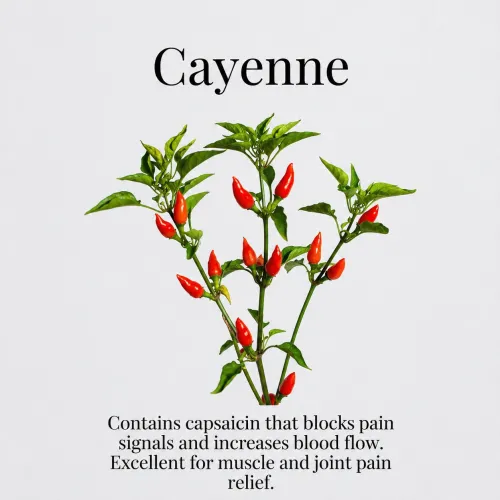
Cayenne pepper (Capsicum annuum) is one of the most extensively studied botanicals in pain management. Its active compound, capsaicin, works through a unique and well-established neurological mechanism — desensitizing TRPV1 (transient receptor potential vanilloid 1) pain receptors in the skin, producing an initial warmth followed by sustained pain relief. Capsaicin-based products are approved by health authorities worldwide as topical analgesics for various pain conditions.
Key Benefits of Cayenne Pepper
- Capsaicin acts on TRPV1 receptors to deplete substance P — the neurotransmitter that carries pain signals — resulting in measurable, lasting pain relief with repeated use. (PubMed reference)
- Clinically demonstrated to reduce pain from osteoarthritis, rheumatoid arthritis, and neuropathic conditions in multiple controlled trials.
- Powerfully increases local circulation — the warmth and flush it creates signals real vasodilation and increased blood flow to underlying tissues and joints.
- Supports muscle recovery after intense physical activity — athletes use capsaicin-based rubs to warm muscles before training and ease soreness after.
- Creates an unmistakable heat sensation that many users describe as deeply satisfying for chronic joint or muscle discomfort — the body reads it as relief.
- Works synergistically with other analgesic botanicals — arnica, ginger, and white willow bark all complement cayenne's action in compound pain formulas.
- Has anti-inflammatory properties beyond its analgesic effect — capsaicin inhibits NF-κB and other pro-inflammatory signaling pathways.
Cayenne is the botanical world's most convincing argument for the power of plants in pain management. Its mechanism is as well-understood as many pharmaceutical analgesics — and its warming, invigorating character turns every application into a moment of active, purposeful self-care.
Traditional Chinese Medicine (TCM) Perspective
Là Jiāo (辣椒) — Cayenne/Chili Pepper — entered Chinese medical practice after its introduction from the Americas, but its warming, dispersing action is fully understood through TCM's classical framework of Cold-dispersing, channel-opening herbs.
- Chinese Name: La Jiao (辣椒) — Cayenne / Chili Pepper
- Nature & Flavor: Hot; Pungent
- Meridians Entered: Heart, Spleen, Stomach
- Key TCM Actions: Strongly warms the middle Jiao and Heart, disperses Cold-Damp, invigorates Blood circulation, opens the channels and collaterals, relieves Bi (painful obstruction) syndrome from Cold.
Capsaicin — the active compound in cayenne — directly activates TRPV1 receptors, which in TCM terms corresponds to powerfully "opening the channels" and "moving stagnant Qi and Blood." Topical cayenne is used in modern Chinese medicine liniments (like Zheng Gu Shui) for Wind-Cold-Damp Bi syndrome: the deep, aching joint and muscle pain that worsens in cold, damp weather.
Ludy & Mattes (2011) RCT: 0.9 g cayenne pepper per meal (providing approximately 5–6 mg capsaicin) increased thermogenesis and reduced caloric intake significantly over 4 weeks. Whiting et al. (2012) systematic review confirmed metabolic effects at this dose. The effect is strongest in people who do not habitually consume spicy food.
Pre-Meal Metabolic Shot
- ¼ tsp cayenne powder (~0.9 g)
- Juice of ½ lemon + 1 tsp apple cider vinegar + 200 ml warm water.
- Drink 15–20 minutes before the two main meals of the day.
- Start with ⅛ tsp and increase over one week.
Research note: The thermogenic response habituates over 3–4 weeks in people who consume capsaicin regularly. Studies show greatest effect in those without prior capsaicin exposure. Avoid on an empty stomach if prone to GERD, gastritis, or IBS-D. Higher doses do not proportionally increase the metabolic effect — 0.9 g/meal is the research-validated optimal amount.
Before you use this: Cayenne is contraindicated in active GERD, gastritis, peptic ulcers, and IBS with diarrhoea predominance — capsaicin directly irritates inflamed gastrointestinal mucosa. Never take the shot on a completely empty stomach. Capsaicin may interact with ACE inhibitor medications (producing or worsening dry cough) and has a mild anti-platelet effect at higher doses — avoid combining with blood-thinning medications without medical guidance. Mucous membrane contact (eyes, nose) causes intense burning; wash hands thoroughly after handling cayenne powder. The information on this page is for educational purposes only and does not constitute medical advice. Every person's health is unique — before incorporating any herb or botanical into your routine, especially if you are pregnant, nursing, managing a health condition, or taking prescription medications, please consult a qualified integrative health professional.


