
Main page content
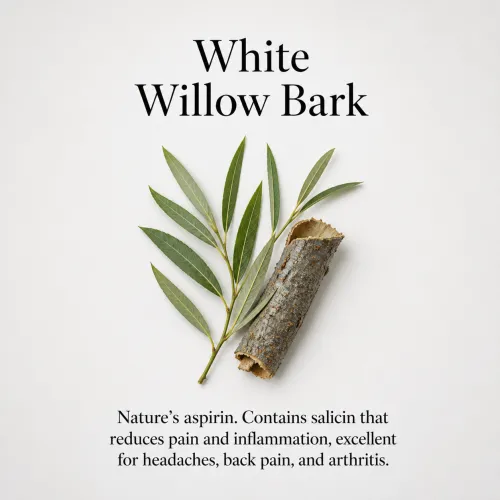
White willow bark (Salix alba) is the botanical ancestor of aspirin — and arguably the plant that launched modern pharmaceutical chemistry. Used for over 4,000 years by healers in ancient Egypt, Greece, China, and among Indigenous peoples worldwide, white willow bark contains salicin, which the body converts to salicylic acid — the active compound that chemists later synthesized as aspirin. Unlike its pharmaceutical descendant, the whole bark delivers its benefits gradually and gently, with fewer gastrointestinal side effects.
Key Benefits of White Willow Bark
- Contains salicin, salicortin, and tremulacin — glycosides that are metabolized in the body to salicylic acid, delivering reliable, sustained analgesic and anti-inflammatory effects with a gentler onset than synthetic aspirin. (PubMed reference)
- Multiple clinical trials confirm efficacy for low back pain — controlled studies show white willow bark extract significantly superior to placebo for acute and chronic lower back pain, with effect sizes comparable to rofecoxib (Vioxx).
- Beyond salicin, contains polyphenols, flavonoids, and tannins that contribute additional anti-inflammatory, antioxidant, and astringent properties not present in synthetic aspirin.
- Inhibits COX-1 and COX-2 prostaglandin synthesis — reducing the production of inflammatory mediators responsible for pain, fever, and swelling.
- Topically, salicylic acid is a celebrated keratolytic and skin-clearing agent — dissolving dead skin cells, unclogging pores, and helping clear blemishes and rough patches.
- Used by Hippocrates, Dioscorides, and Culpeper — the herb is documented in virtually every major Western medical text from antiquity to the 19th century as a primary remedy for pain and fever.
- Works synergistically with arnica, devil's claw, and boswellia in multi-herb formulations — each contributing a distinct anti-inflammatory mechanism for comprehensive, layered pain relief.
White willow bark is where botanical medicine and pharmaceutical history intersect — the plant that gave us aspirin but still outperforms it in key ways. Its whole-plant complexity, gentler metabolic profile, and 4,000-year track record of safety make it one of the most credible and important analgesic botanicals in natural medicine.
Traditional Chinese Medicine (TCM) Perspective
White Willow Bark contains salicin — the precursor to aspirin — and its anti-inflammatory, fever-reducing properties connect it to TCM's category of herbs that clear Heat, resolve toxins, and reduce fever and pain. Chinese willow species (Liǔ Shù Pí, 柳树皮) appear in Chinese folk medicine traditions.
- Chinese Name: Liu Shu Pi (柳树皮) — Willow Bark; Bai Liu Shu (白柳树) — White Willow
- Nature & Flavor (functional): Cold; Bitter
- Meridians Entered (functional): Liver, Heart
- Key TCM Actions: Clears Heat and reduces fever, resolves toxins, relieves pain from Heat patterns (Heat Bi syndrome), moves Blood mildly, reduces inflammation in the channels and joints.
Salicin-rich plants align most closely with TCM's "Xī Fēng Shī Rè" (祛风湿热) category — herbs that dispel Wind-Damp-Heat from the channels and relieve Hot Bi syndrome: the pattern of joint inflammation with heat, redness, and swelling characteristic of acute rheumatoid flares. White willow bark's ability to inhibit COX enzymes and reduce prostaglandin synthesis corresponds to TCM's "clearing Fire from the channels and cooling the Blood to stop pain."
Schmid et al. (1998, 2001) RCTs: white willow bark extract providing 240 mg salicin/day significantly reduced chronic low back pain over 4 weeks, with effect size comparable to rofecoxib (12.5 mg). Chrubasik et al. (2001) confirmed. Standard dried bark provides 1–4 % salicin by weight; a 15–25 g bark decoction yields approximately 150–300 mg salicin. Critical detail: start in cold water — salicin extraction is markedly higher from a cold-start decoction than hot-water addition.
Willow Bark Pain Decoction
- 15–25 g dried white willow bark in 500 ml cold water.
- Bring slowly to a gentle simmer, cook uncovered on low heat for 20–25 minutes.
- Strain. Divide into 2 portions. Drink across the day (morning and evening with food).
- Add a cinnamon stick while simmering to improve palatability.
Research note: Salicin is a prodrug — it converts to salicylic acid in the liver, which is why white willow bark has a slower onset but longer duration than aspirin. Allow 7–14 days of consistent daily use for measurable anti-inflammatory effect. Contraindicated in aspirin allergy. Do not use concurrently with NSAIDs, anticoagulants (warfarin, heparin), or before surgery. Avoid in children and adolescents (Reye's syndrome risk). Do not use during pregnancy.
Before you use this: Contraindicated in aspirin allergy — salicin is metabolised to salicylate (the same compound as aspirin). Do not use if you have ever had an allergic or asthmatic reaction to aspirin or other NSAIDs. Do not give to children or adolescents with viral illness — salicylate compounds are associated with Reye's syndrome in this context. Avoid with warfarin, NSAIDs, anticoagulants, and blood-thinning medications. Do not use in the 2 weeks before surgery. Avoid entirely during pregnancy. Do not use white willow bark to mask fever without seeking diagnosis of the underlying cause. The information on this page is for educational purposes only and does not constitute medical advice. Every person's health is unique — before incorporating any herb or botanical into your routine, especially if you are pregnant, nursing, managing a health condition, or taking prescription medications, please consult a qualified integrative health professional.


