

Retinol is the ingredient every skin clinic talks about: it speeds up the way skin renews itself and tells it to build fresh collagen. It also leaves a lot of faces red, flaky and stinging. So here is the good news. A small brown seed that Ayurveda and Chinese medicine have used on skin for centuries went head to head with retinol in a clinical trial and matched it, and the hips of a wild rose press into an oil that carries a little vitamin A of its own. This post shows you what they are, what they did in the studies, what real people say after months of use, and how to put both on your face tonight.
Meet the babchi seed
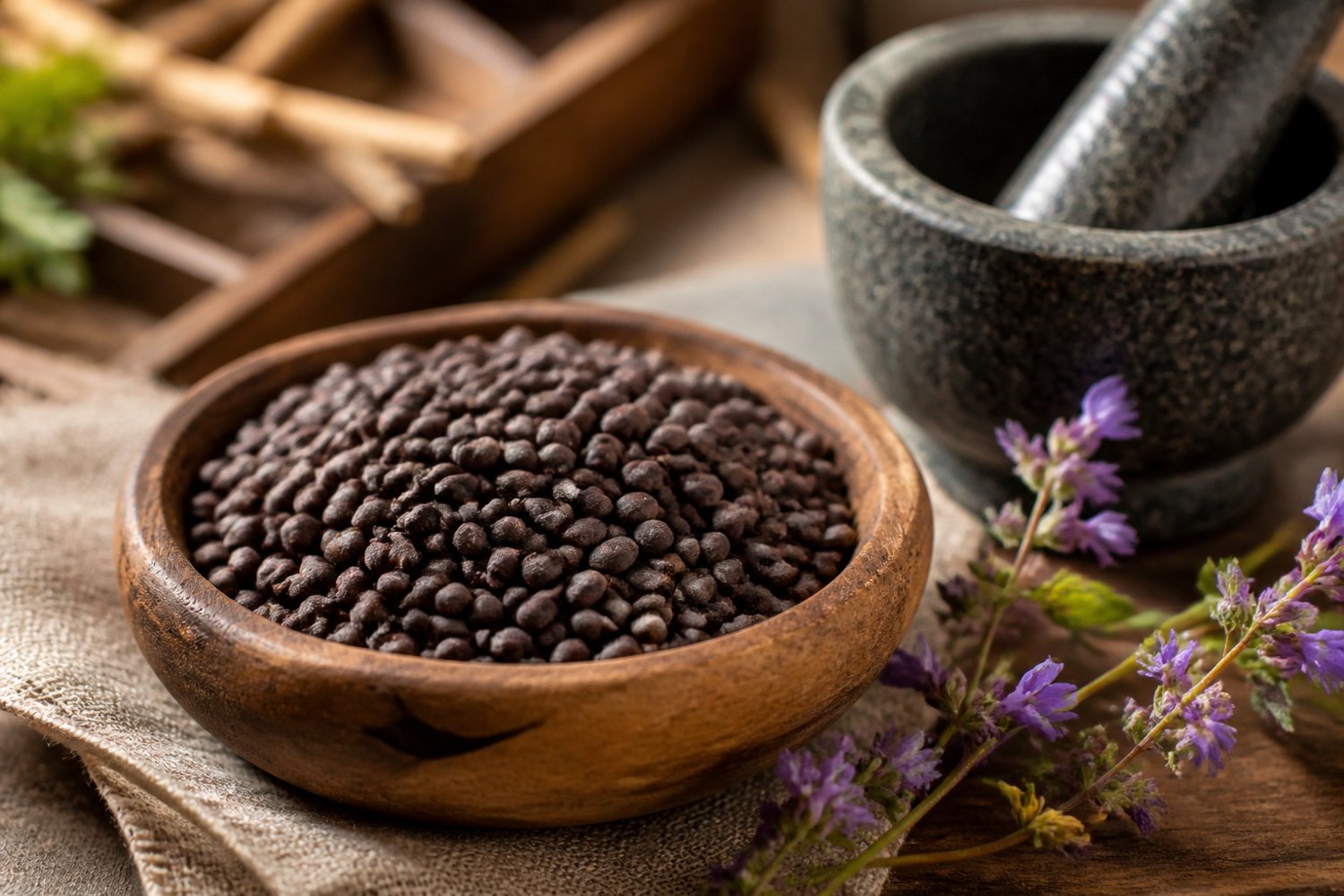
Bakuchiol (say it "buh-KOO-chee-ol") comes from the seeds and leaves of the babchi plant, Psoralea corylifolia, a purple-flowered herb that grows across India and China. Ayurveda calls the plant bakuchi and has long counted it among its great skin herbs. Chinese medicine calls the seed Bu Gu Zhi, a warming tonic for the Kidney that is also soaked in alcohol and dabbed on the skin. Two medical traditions, a continent apart, both reached for the same seed when the skin needed help [1].
What did they know? In 2014 researchers finally looked at what bakuchiol does inside skin. It looks nothing like retinol as a molecule, yet it switched skin genes on and off in a strikingly similar pattern, and it raised the production of collagen types I, III and IV, the proteins that keep skin firm and springy. In the same paper, people who used a bakuchiol product twice a day for 12 weeks had significant improvements in lines and wrinkles, pigmentation, elasticity and firmness, without the usual retinol irritation [2].
Bakuchiol vs. retinol: the head-to-head trial
The study everyone quotes came from dermatologists at the University of California, Davis. In their randomized, double-blind trial, 44 people used either 0.5% bakuchiol cream twice a day or 0.5% retinol cream once a day for 12 weeks. High-resolution photographs were analysed at weeks 4, 8 and 12. The result: both creams significantly reduced wrinkle surface area and dark spots, with no statistical difference between them. The retinol group reported more scaling and stinging [3].
It gets better for sensitive faces. In a 2020 study led by dermatologist Zoe Draelos, 60 women aged 40 to 65 with sensitive skin (a third with eczema, a third with rosacea, a third who react to most cosmetics) used a bakuchiol cleanser and moisturizer for four weeks. The products were well tolerated, skin looked smoother, clearer and more radiant, and skin moisture rose by 16% [4]. A 2022 systematic review of bakuchiol in dermatology pulled the research together and reached the same picture: retinol-like results, gentler on the skin [5].
Dermatologist Dr Dray walks through the comparison in this video, which has passed 219,000 views:
Rosehip: the wild rose that feeds your skin
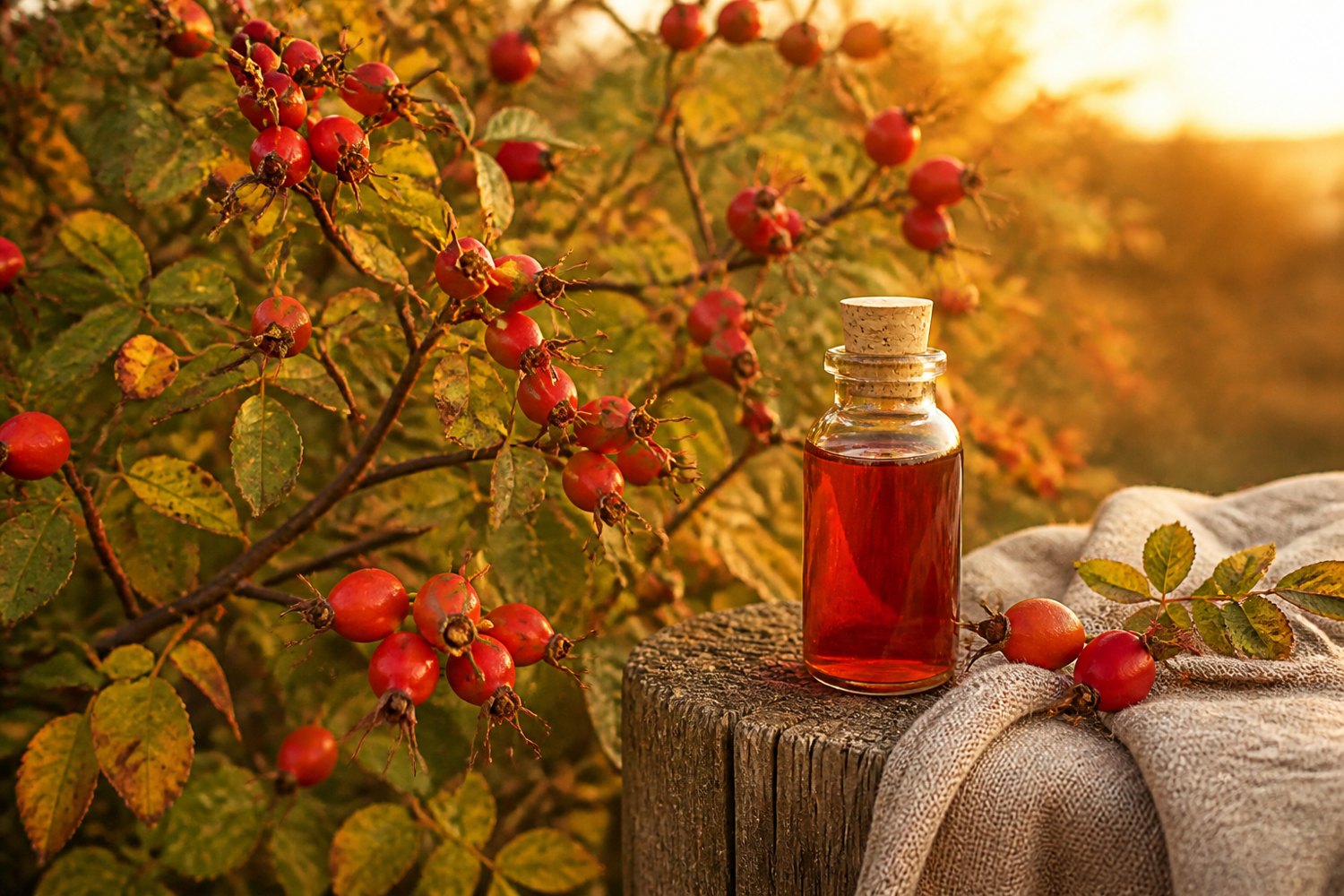
When the petals fall from a wild rose, the plant leaves behind a bright red fruit: the rosehip. Press its seeds and you get an orange-red oil that the people of the Chilean Andes have rubbed into their skin for generations, under the name rosa mosqueta.
Three things make it special:
- It carries natural vitamin A. A study of how the oil is extracted measured all-trans-retinoic acid, the active form of vitamin A, in rosehip oil, and found that cold pressing kept about seven times more of it than solvent extraction [6]. That is why the label should say cold-pressed.
- It is full of the fats skin is built from. Rosehip oil is rich in linoleic and linolenic acids, which a review of plant oils on the skin links to a stronger skin barrier and calmer inflammation [7].
- Its colour is its medicine. The orange comes from carotenoids, the same family of protective pigments found in carrots and sea buckthorn.
Rosehip has a long history with wounds and scars too. A 2024 review of rosehip and wound healing gathers that research in one place [8].
And rosehip works from the inside as well. In a randomized, double-blind study, 34 adults aged 35 to 65 took a rosehip powder made from the seeds and shells for 8 weeks. Their crow's-feet wrinkles, skin moisture and elasticity all improved significantly, matching astaxanthin, a well-known skin supplement [9]. Rosehip tea, anyone?
What people say after months of use
Studies are one lens. Here is what people report in public after living with these two for a while. We link every account so you can read it yourself.
- Four years of rosehip oil, with photos. YouTuber LittlePoet filmed her four-year results with rosehip seed oil, before-and-after pictures included. More than 74,000 people have watched it (video below).
- "My fine lines have absolutely reduced." That is Lucy Searle, a director at the magazine woman&home, after about two months and one 30 ml bottle of rosehip oil. She also wrote that her skin "has gained a definite, discernible glow" (woman&home).
- A scar that faded, sunspots that did not. Natural-beauty blogger Petra Nakashian used rosehip oil twice a day for about six weeks. A burn scar on her hand "has really lightened" and her fine lines looked softer, but the sunspots on her face did not fade, and after two weeks of holiday sun her pigmentation "looked worse than when I first started" (Green Beauty Talk). Her lesson is a good one: an oil is not a sunscreen.
- Seven weeks of bakuchiol, mixed results. A writer at Cool Mom Picks used a bakuchiol serum morning and night for seven weeks. The fine lines under her eyes improved the most, but her crow's feet stayed and her skin texture did not change as much as she hoped (Cool Mom Picks). The trials ran 12 weeks, so patience matters.
The pattern across these accounts: glow and softness come first, often within weeks. Fine lines take two to three months. Deep wrinkles and old sunspots are the slowest to move. Faces differ, so give it a fair 12 weeks before you judge.
5 ways to use them
1. Rosehip oil, straight
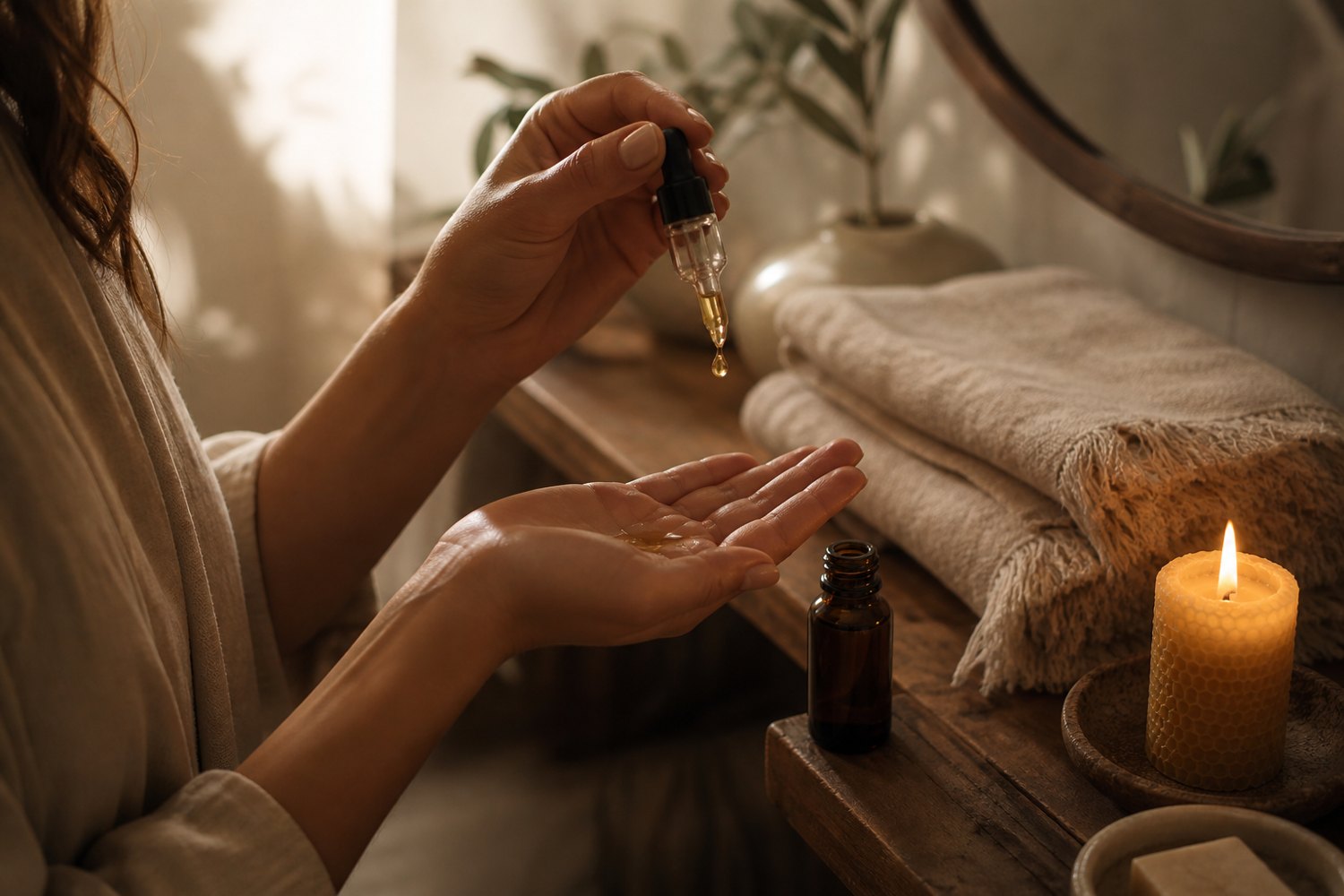
The simplest ritual in skin care. After washing, while your face is still a little damp, warm 3 or 4 drops of cold-pressed rosehip oil between your palms and press it in. Night is best. Keep the bottle in a cool, dark place, or in the fridge, because its delicate fats go off with heat and light. Fresh oil smells earthy and a little nutty.
2. A bakuchiol serum, morning and night
Look for a product that states its strength. The UC Davis trial used 0.5%, twice a day. Unlike retinol, bakuchiol was used in the morning too.
3. Our favourite: the two-plant night oil
Make your own. Into a 1 oz (30 ml) dark glass dropper bottle, pour cold-pressed rosehip oil almost to the top, then add 6 drops of pure cosmetic-grade bakuchiol. Cap and shake. That gives you roughly 0.5 to 1% bakuchiol in a base that brings its own vitamin A and skin-building fats. Use 3 or 4 drops at night. One bottle lasts about two months.
4. Bakuchiol alongside retinol
If you already use retinol and it bites, try bakuchiol on the nights between. Many people use the two together.
5. Rosehips in the cup
Dried rosehips make a tart, ruby-red tea that is loaded with vitamin C, the vitamin your body needs to build collagen. Steep a tablespoon of crushed dried hips in just-boiled water for 10 to 15 minutes, covered. Want to make an infused oil from hips you picked yourself? This step-by-step video shows how:
Good to know
- Bakuchiol is not the same as raw babchi oil. The whole seed also contains psoralens, which make skin more sensitive to sunlight. Purified bakuchiol does not carry them. For your face, use purified bakuchiol.
- Patch test first. Try any new oil on your inner arm for a day or two. A few people react to rosehip oil.
- Keep your sun care. These two rebuild; they do not block the sun.
From our apothecary
For the tea side of this story, our Hibiscus Rose Tea is a tart, floral cup in the same family as rosehip tea, and our loose hibiscus flowers blend beautifully with dried rosehips.
More from the Skin Rejuvenation Series
Related reading
- Herbal Salves and Balms: What Really Goes Into a Truly Healing Recipe
- Herbal Salve for Eczema: 5 Herbs That Calm Irritated Skin Naturally
References
- Chen L et al. "Psoralea corylifolia L.: a comprehensive review of its botany, traditional uses, phytochemistry, pharmacology, toxicology, quality control and pharmacokinetics." Chin Med. 2023.
- Chaudhuri RK, Bojanowski K. "Bakuchiol: a retinol-like functional compound revealed by gene expression profiling and clinically proven to have anti-aging effects." Int J Cosmet Sci. 2014.
- Dhaliwal S et al. "Prospective, randomized, double-blind assessment of topical bakuchiol and retinol for facial photoageing." Br J Dermatol. 2019.
- Draelos ZD et al. "Clinical Evaluation of a Nature-Based Bakuchiol Anti-Aging Moisturizer for Sensitive Skin." J Drugs Dermatol. 2020.
- Puyana C et al. "Applications of bakuchiol in dermatology: Systematic review of the literature." J Cosmet Dermatol. 2022.
- Concha J et al. "Effect of rosehip extraction process on oil and defatted meal physicochemical properties." J Am Oil Chem Soc. 2006.
- Lin TK et al. "Anti-Inflammatory and Skin Barrier Repair Effects of Topical Application of Some Plant Oils." Int J Mol Sci. 2017.
- Belkhelladi M, Bougrine A. "Rosehip extract and wound healing: A review." J Cosmet Dermatol. 2024.
- Phetcharat L et al. "The effectiveness of a standardized rose hip powder, containing seeds and shells of Rosa canina, on cell longevity, skin wrinkles, moisture, and elasticity." Clin Interv Aging. 2015.
These statements have not been evaluated by the Food and Drug Administration. Our products are not intended to diagnose, treat, cure, or prevent any disease.


