
Main page content
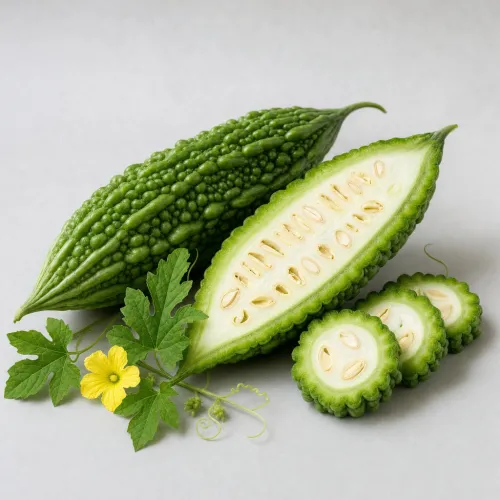
Bitter melon (Momordica charantia), also called bitter gourd, karela and kǔ guā, is a climbing vine of the gourd family whose warty green fruit is eaten as a vegetable and taken as medicine from India to China to the Caribbean. It is one of the most intensely bitter foods a person can eat, and that bitterness is exactly why every tradition that knows it reaches for it when the body has too much sugar and too much heat. Ayurveda has prescribed karela for prameha, the family of urinary and metabolic disorders that includes what the West now calls diabetes, for well over a thousand years. Its fruit holds three compounds that modern researchers keep returning to: charantin, vicine, and polypeptide-p, a protein so close in action to animal insulin that it is often called "plant insulin."
Key Benefits of Bitter Melon
- Contains polypeptide-p ("plant insulin"), charantin and vicine, compounds that act on blood sugar through several different pathways at once.
- Activates AMPK, the same cellular energy switch targeted by metformin, helping muscle and liver cells take up glucose. (Tan et al., 2008)
- In a four-week trial, 2,000 mg a day of bitter melon lowered fasting blood sugar and fructosamine in people with type 2 diabetes. (Fuangchan et al., 2011)
- Traditionally used to support the pancreas, and in animal studies it helps preserve the insulin-producing beta cells.
- Ayurveda's premier herb for prameha — bitter (tikta) taste that reduces Kapha, clears excess sweetness from the blood, and stirs a sluggish liver.
- Used in Caribbean, Amazonian and African folk medicine for fevers, digestion, worms and skin conditions — the same plant, reached independently on three continents.
Bitter melon is the clearest example in the plant world of a taste doing medicine. Traditions that never met each other all landed on the same conclusion: a bitter that strong belongs in the hands of anyone whose blood carries too much sugar. Research is now catching up, and the funding to properly study it, as with most plants that cannot be patented, has been thin.
Traditional Chinese Medicine (TCM) Perspective
- Chinese Name: Kǔ Guā (苦瓜) — "Bitter Gourd"
- Nature & Flavor: Cold; Bitter
- Meridians Entered: Heart, Spleen, Stomach, Liver
- Key TCM Actions: Clears Heat and relieves Summer-Heat, clears Heat-toxin, brightens the eyes, quenches thirst.
In TCM, the pattern Western medicine calls diabetes is Xiāo Kě (消渴) — "wasting and thirsting." Classically it is described as Heat burning through the body's fluids: constant thirst in the Upper Burner, constant hunger in the Middle, and frequent urination in the Lower. Kǔ Guā's cold, bitter nature goes straight at that Heat and the thirst that comes with it, which is why it has been eaten as a food-medicine in southern China for exactly this purpose. Because it is so cold, a TCM practitioner would rarely give it alone for long — it is balanced with warming herbs so it clears the Heat without chilling the Spleen's digestive fire.
The traditional way to take bitter melon is as food: thin slices of the fresh fruit, salted for 10 minutes and rinsed to soften the bitterness, then stir-fried with egg, garlic or onion. Asian groceries carry both the slender Indian karela and the paler, smoother Chinese variety.
- Juice: 30–50 ml of fresh bitter melon juice on an empty stomach in the morning — the classic Ayurvedic preparation. Start with 15 ml.
- Tincture: taken under the tongue before meals, ideally combined with warming herbs such as cinnamon, fenugreek or galangal to balance its cold nature.
- Dried slices: 2–3 g simmered in water for 10 minutes as a tea.
Research note: trial results have been mixed — partly because studies use different preparations, doses and parts of the plant. The strongest results come from whole fruit and fruit extract, not the seeds.
Before you use this: Bitter melon lowers blood sugar, and it adds to the effect of insulin and oral diabetes medications — if you take either, watch your levels closely when you start. Do not use during pregnancy (the seeds and fruit contain compounds that can stimulate the uterus) or while trying to conceive. Not for children. Avoid if you have G6PD deficiency — the seeds contain vicine, which can trigger favism-type anemia. Large amounts may cause stomach upset. The information on this page is for educational purposes only and does not constitute medical advice. Every person's health is unique — before incorporating any herb or botanical into your routine, especially if you are pregnant, nursing, managing a health condition, or taking prescription medications, please consult a qualified integrative health professional.

Share this with your friends 🙏


