Main page content
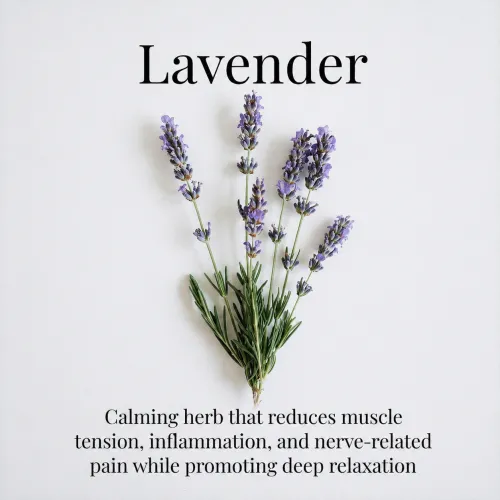
Lavender (Lavandula angustifolia) essential oil is arguably the world's most studied and widely used therapeutic essential oil — and with good reason. Its research dossier spans anxiety reduction, wound healing, pain relief, antimicrobial activity, and sleep support. First systematically studied by René-Maurice Gattefossé (who coined the term "aromatherapy" after using lavender on a burn), lavender remains the gold standard botanical for skin healing, calming, and versatile everyday use.
Key Benefits of Lavender Essential Oil
- Extensive clinical evidence for anxiety and stress reduction — oral lavender preparations (Silexan) are approved in Germany as a prescription treatment for anxiety, with effect sizes comparable to lorazepam. (PubMed reference)
- Rich in linalool and linalyl acetate — compounds that modulate GABA receptors in the brain, producing genuine calming and anxiolytic effects through inhaled aromatherapy.
- Well-documented wound healing properties — speeds epithelialization, reduces scarring, and has anti-inflammatory effects at the site of minor cuts, burns, and skin damage.
- Broad-spectrum antimicrobial activity — effective against bacteria, fungi, and some viruses, supporting skin health and preserving formulations.
- Reliably improves sleep quality and duration — multiple studies in diverse populations confirm lavender aromatherapy improves sleep onset, depth, and morning alertness.
- Provides genuine topical pain relief — clinical trials on headache, arthritis pain, and post-operative pain all show measurable benefit from lavender application or inhalation.
- The most universally trusted first-aid botanical — used safely on burns, bites, wounds, and skin irritations for 100 years of modern aromatherapy practice.
Lavender is the botanical that opened the door to modern aromatherapy — and after a century of research, it remains the most credible, most versatile, and most beloved essential oil in the world. Every serious natural formulator keeps lavender at the center of their practice.
Traditional Chinese Medicine (TCM) Perspective
Lavender (Xūn Yī Cǎo, 薰衣草) has been adopted into modern Chinese herbal practice as a calming, Wind-clearing, Heat-reducing aromatic herb. Its ubiquitous use in stress management and sleep support aligns directly with TCM's approach to Heart Shen disturbances.
- Chinese Name: Xun Yi Cao (薰衣草) — Lavender
- Nature & Flavor: Cool; Pungent, slightly Bitter
- Meridians Entered: Heart, Liver, Lung
- Key TCM Actions: Calms the Heart and anchors the Spirit (Shen), clears Liver Heat and Internal Wind, cools Blood Heat (skin inflammation), opens the Lung and benefits the throat, relieves pain through aromatic channel-opening.
In TCM, insomnia, anxiety, and palpitations are understood as expressions of the Heart Spirit (Shen) losing its stable abode — often due to Heart Blood deficiency, Heart Fire, or Liver Wind harassing the Heart. Lavender's documented GABA-modulating, anxiolytic action is precisely the TCM mechanism of "calming the Heart and quieting the Spirit." Its cooling nature also makes it ideal for inflammatory skin conditions rooted in Blood Heat — a major TCM dermatological pattern.
Note: The essential oil is not for internal use. For internal therapeutic effect, use dried culinary lavender herb as a tea. Kasper et al. (2010) RCT: Silexan (80 mg standardised lavender oil capsule) significantly reduced generalised anxiety over 4 weeks — but this is a pharmaceutical-grade enteric-coated preparation, not home-blended oil. For the sleep and anxiety benefits available without pharmaceutical preparations: Lewith et al. (2005) confirmed improved sleep quality with lavender aromatherapy (2 drops on pillowcase). Culinary lavender tea at 1 tsp dried herb per cup is the accessible daily option.
Lavender Sleep Tea
- 1 tsp dried culinary lavender flowers (food-grade, not ornamental) in 200 ml hot water (not boiling — 85 °C).
- Steep 5–7 minutes, covered.
- Add 1 tsp honey + optional chamomile blend (equal parts).
- Drink 30–45 minutes before bed.
Research note: Ensure you use food-grade culinary lavender (Lavandula angustifolia), not Lavandula latifolia (spike lavender) or ornamental varieties that may contain camphor at levels unsuitable for regular consumption. For aromatherapy sleep benefit, simultaneously place 2 drops of lavender essential oil on a tissue near the pillow — combining oral and olfactory routes delivers broader-spectrum effect than either alone.
Before you use this: This recipe uses dried culinary lavender herb, not the essential oil. Do not ingest lavender essential oil — it is not approved for internal use at standard aromatherapy concentrations. Use food-grade Lavandula angustifolia only; Lavandula latifolia (spike lavender) has significantly higher camphor content and is not appropriate for consumption. Avoid therapeutic doses during pregnancy — lavender has traditional classification as an emmenagogue. Lavender tea may cause mild drowsiness; do not drive or operate heavy machinery directly after consuming. Rare lavender allergy exists, particularly in those sensitive to other Lamiaceae plants. The information on this page is for educational purposes only and does not constitute medical advice. Every person's health is unique — before incorporating any herb or botanical into your routine, especially if you are pregnant, nursing, managing a health condition, or taking prescription medications, please consult a qualified integrative health professional.


